UPSC Prelims 2026: 28 questions BLOOM notes had covered
BLOOM UPSC launched on 22 February 2026. The UPSC Prelims paper came on 24 May. By then, BLOOM notes and mock tests had covered 28 of its questions: 3 word for word, 10 in full and 15 by topic, though not every fact the question tested. Each one is below: the note as it was published, the real question beside it, and both as text.
This is evidence from UPSC, a different examination. It is not an APPSC result, selection rate or promise of marks. The APPSC notes are written with the same method.
3Word-for-word exact matches
10Covered in full
15Topic covered, not every fact
91Days from launch to the paper
Section 01 · 9 questions
History, Culture & Environment
Art & culture, ancient history, geography and the environment.
Art & Culture·UPSC Q27Exact match01/28
Moidams of the Ahom kings
Our mockOur mock
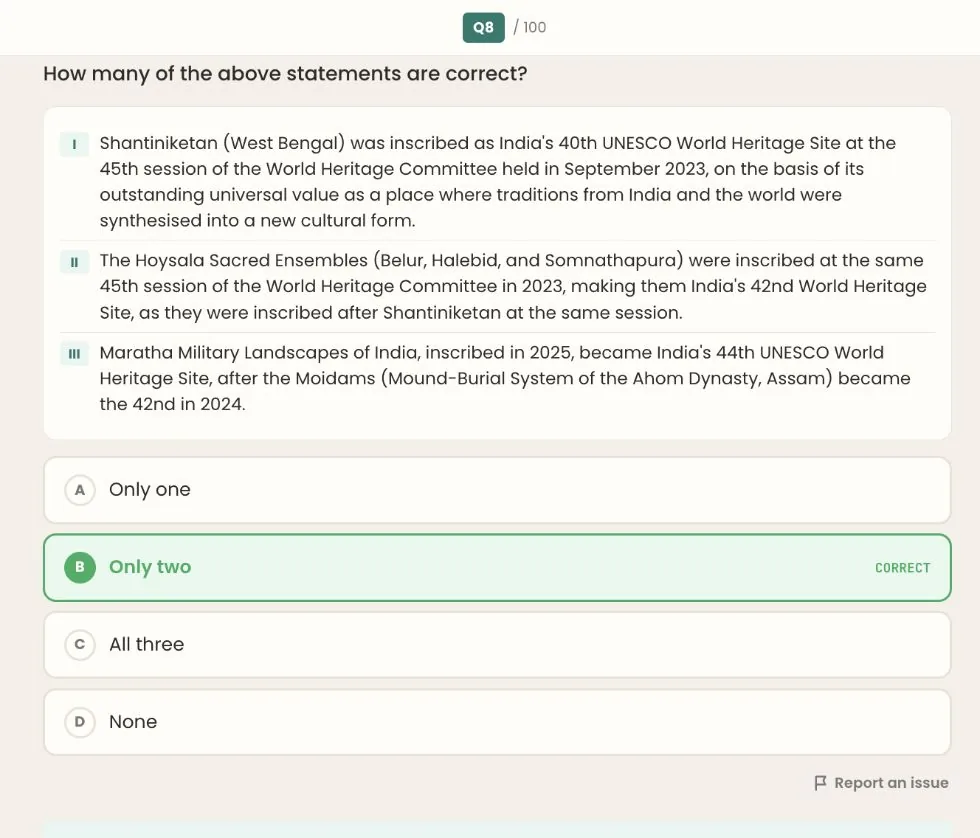
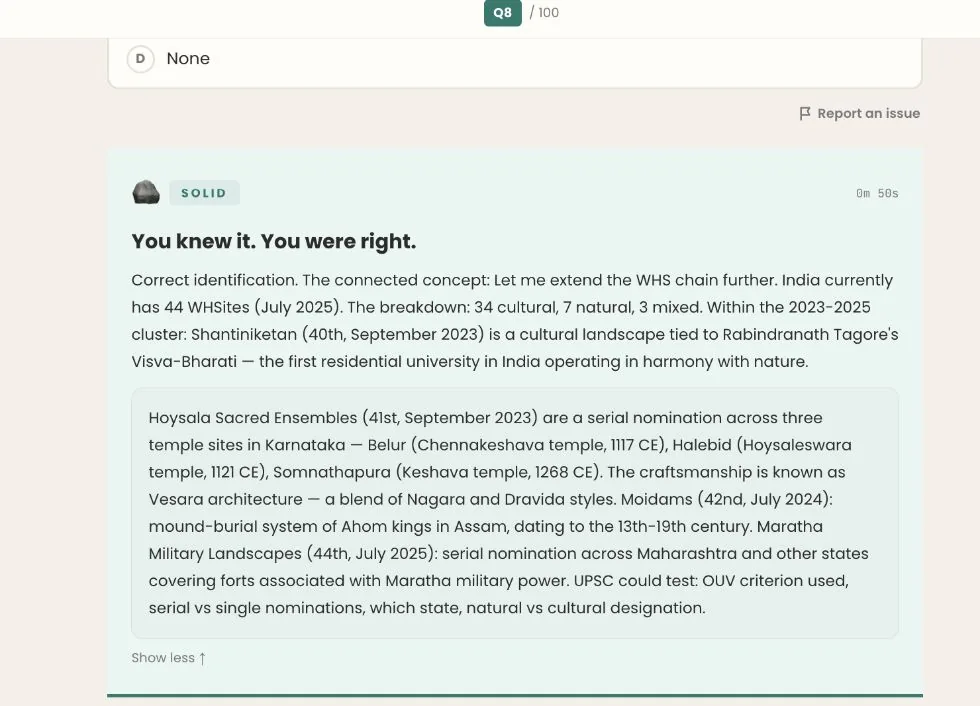
Our mock called Moidams the burial system of the Ahom kings, which is what UPSC Q27 asked. India’s 43rd UNESCO site (2024), and the first from the Northeast.
The note, as text
BLOOM mock question: three statements on UNESCO World Heritage Sites inscribed in 2023 to 2025, including the Moidams of Assam.
Moidams are the mound-burial system of the Ahom kings in Assam, built from the 13th to the 19th century, and inscribed by UNESCO in July 2024.
The same set: Santiniketan and the Hoysala Sacred Ensembles (Belur, Halebid, Somnathapura) in September 2023, and the Maratha Military Landscapes in July 2025.
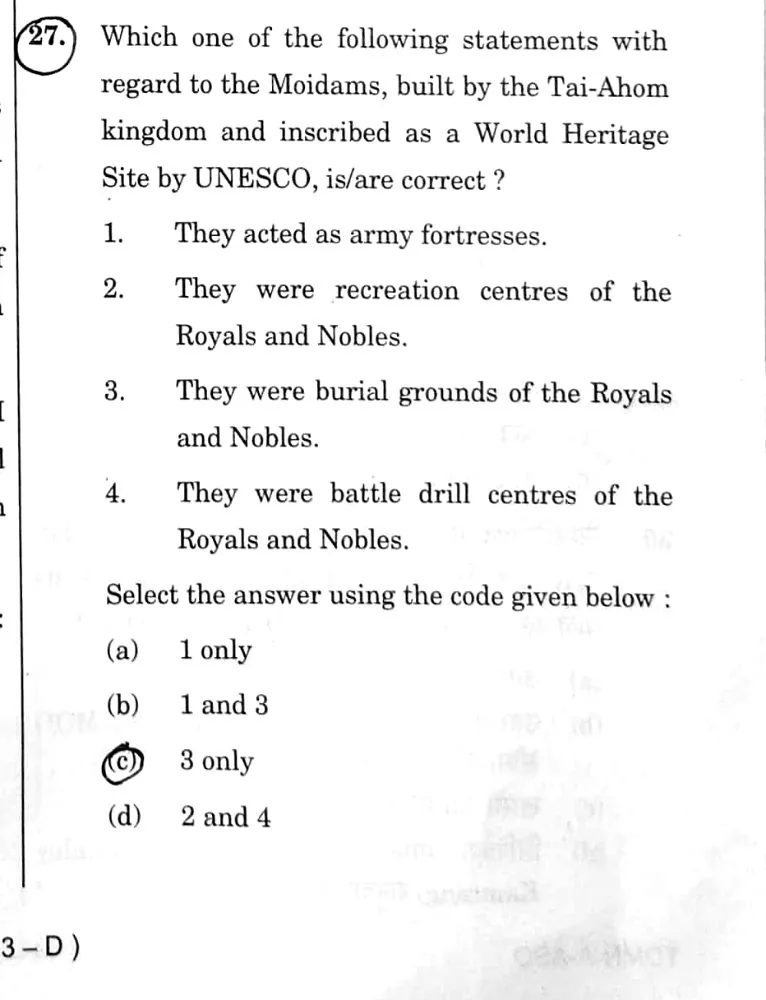
The UPSC question: GS Series D, Q27
The actual paper · GS Series D · Q27
The question, as text
UPSC Prelims 2026, GS Series D, Q27. Which one of the following statements with regard to the Moidams, built by the Tai-Ahom kingdom and inscribed as a World Heritage Site by UNESCO, is/are correct?
They acted as army fortresses.
They were recreation centres of the Royals and Nobles.
They were burial grounds of the Royals and Nobles.
They were battle drill centres of the Royals and Nobles.
Select the answer using the code given below: (a) 1 only (b) 1 and 3 (c) 3 only (d) 2 and 4
Art & Culture·UPSC Q4Covered02/28
Amaravati Stupa
Our note
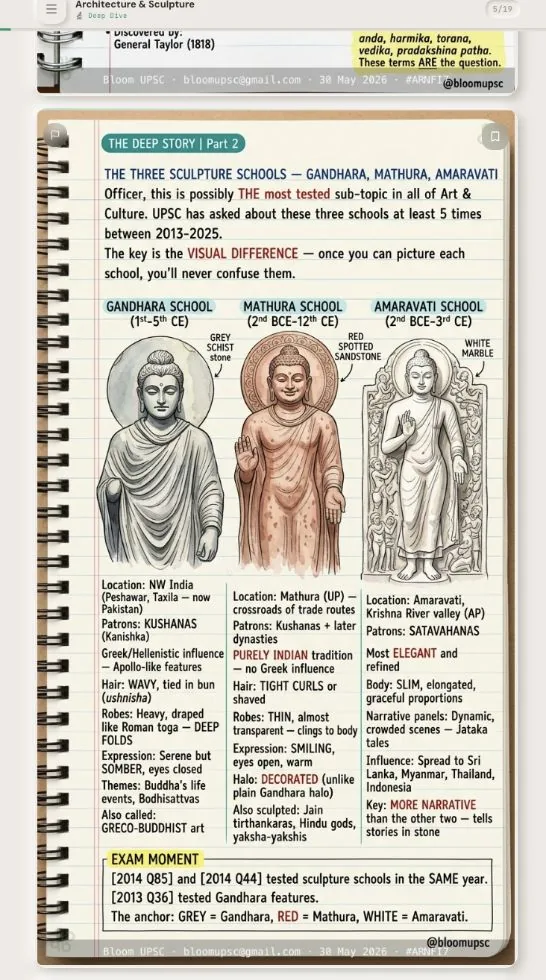
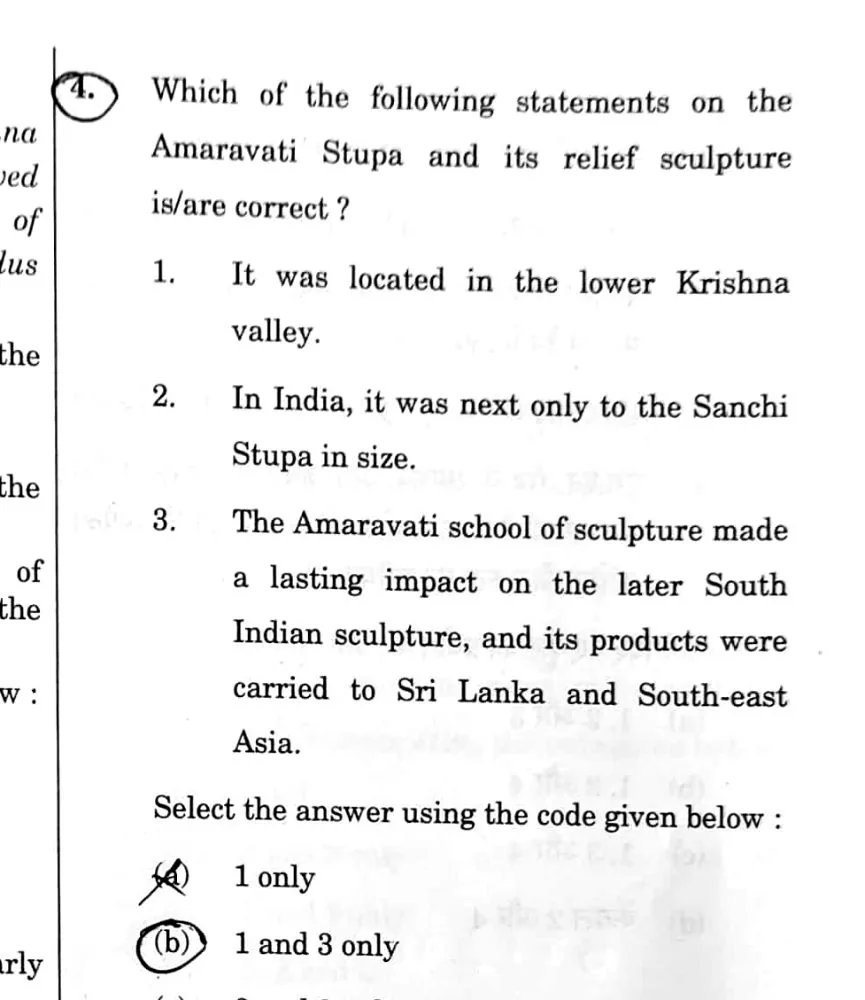
We covered the Amaravati Stupa. Came as UPSC Q4.
The note, as text
BLOOM note on the three sculpture schools: Gandhara (grey schist), Mathura (red spotted sandstone) and Amaravati (white marble).
Amaravati school: Krishna River valley in Andhra Pradesh, patronised by the Satavahanas, 2nd century BCE to 3rd century CE.
Slim, graceful figures and crowded narrative panels of Jataka tales. Its influence spread to Sri Lanka, Myanmar, Thailand and Indonesia.
The UPSC question: GS Series D, Q4
The actual paper · GS Series D · Q4
The question, as text
UPSC Prelims 2026, GS Series D, Q4. Which of the following statements on the Amaravati Stupa and its relief sculpture is/are correct?
It was located in the lower Krishna valley.
In India, it was next only to the Sanchi Stupa in size.
The Amaravati school of sculpture made a lasting impact on the later South Indian sculpture, and its products were carried to Sri Lanka and South-east Asia.
Select the answer using the code given below: (a) 1 only (b) 1 and 3 only. Options (c) and (d) are cut off in this picture of the paper.
Ancient History·UPSC Q5Topic covered03/28
Tamilakam dynasties
Our mockOur mock
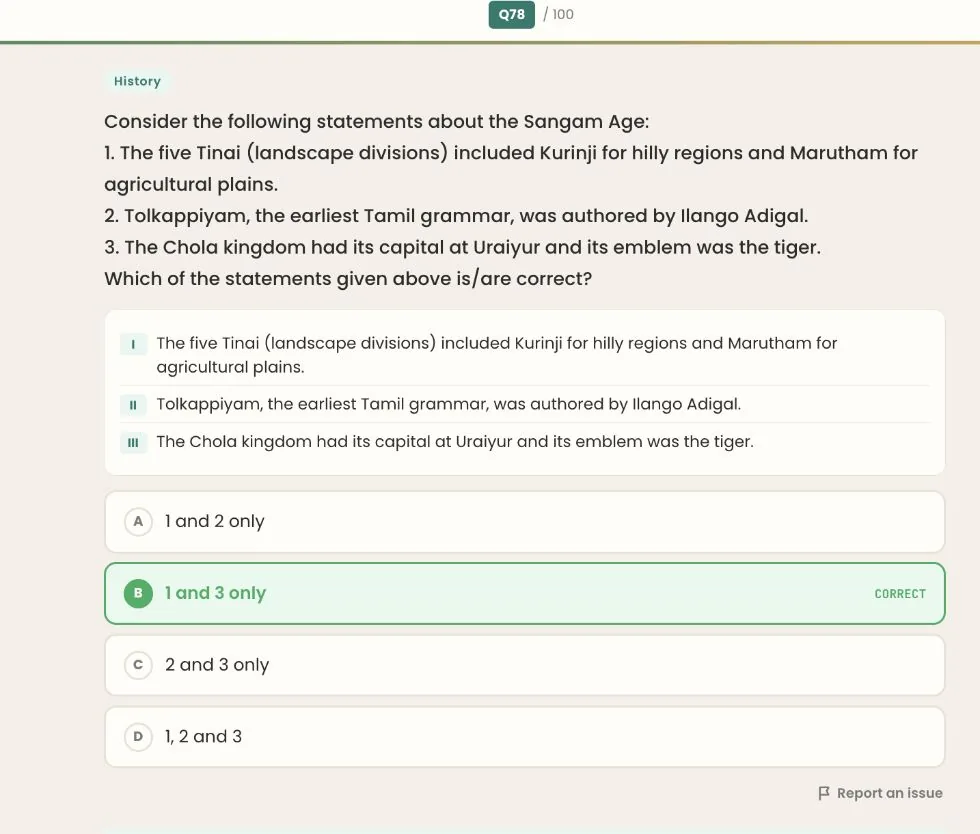
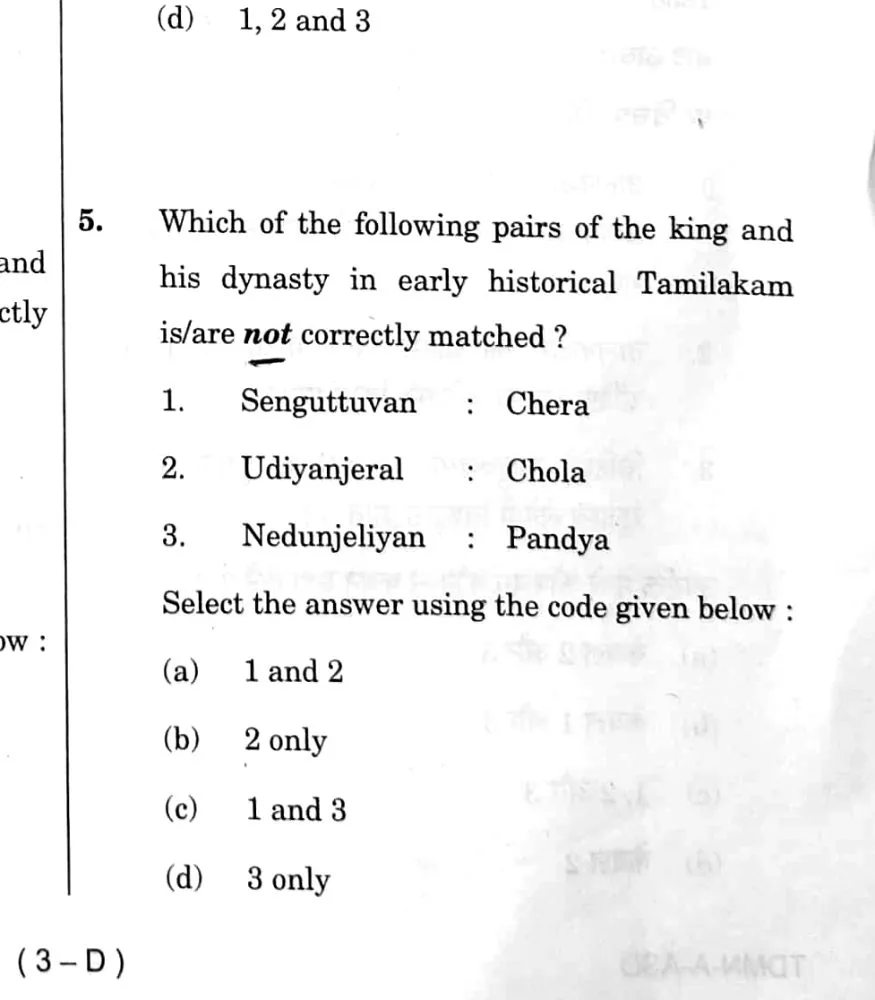
We covered the early Tamilakam dynasties. Came as UPSC Q5.
The note, as text
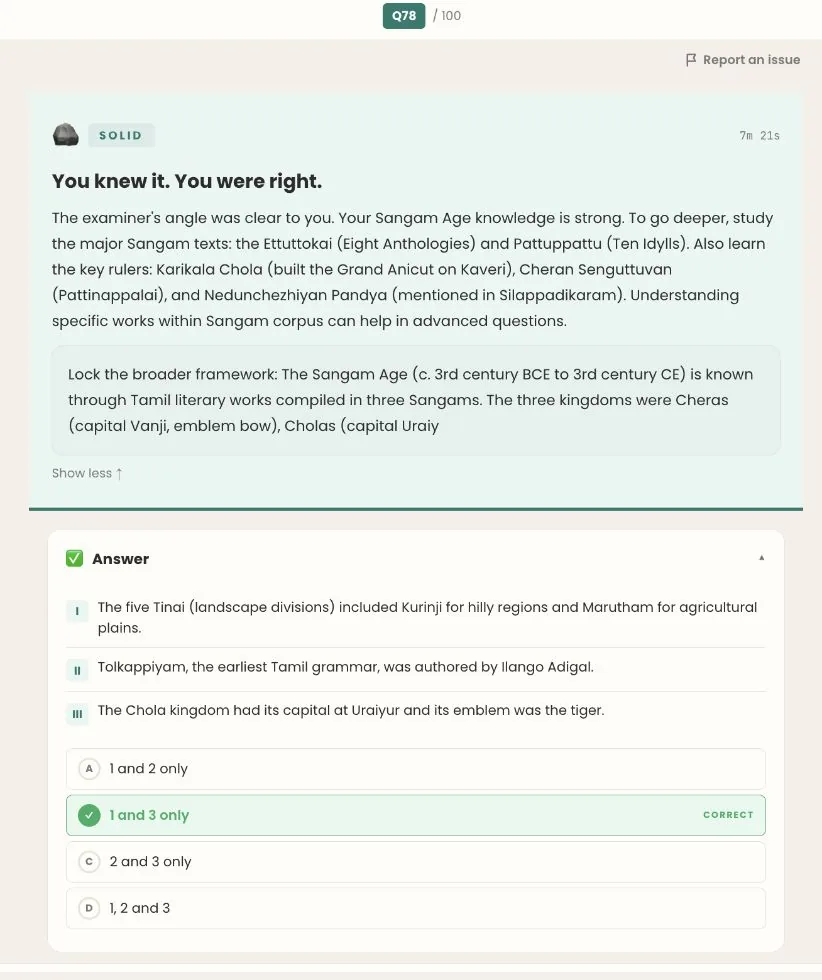
BLOOM mock question on the Sangam Age: statements on the five Tinai, the author of Tolkappiyam and the Chola kingdom, with answer choice B (1 and 3 only) marked correct.
The five Tinai (landscape divisions) included Kurinji for hilly regions and Marutham for agricultural plains. The Chola kingdom had its capital at Uraiyur and its emblem was the tiger.
The explanation lists the Sangam texts Ettuttokai and Pattuppattu, and the rulers Karikala Chola, Cheran Senguttuvan and Nedunchezhiyan Pandya. It names the three kingdoms as Cheras, Cholas and Pandyas.
The UPSC question: GS Series D, Q5
The actual paper · GS Series D · Q5
The question, as text
UPSC Prelims 2026, GS Series D, Q5. Which of the following pairs of the king and his dynasty in early historical Tamilakam is/are not correctly matched ?
1. Senguttuvan : Chera
2. Udiyanjeral : Chola
3. Nedunjeliyan : Pandya
Select the answer using the code given below : (a) 1 and 2 (b) 2 only (c) 1 and 3 (d) 3 only. The top of the page shows the end of the previous question; the question number 5 is fully visible in this picture of the paper.
Ancient History·UPSC Q13Topic covered04/28
Pali texts & early coinage
Our note
We covered Pali texts & early coinage. Came as UPSC Q13.
The note, as text
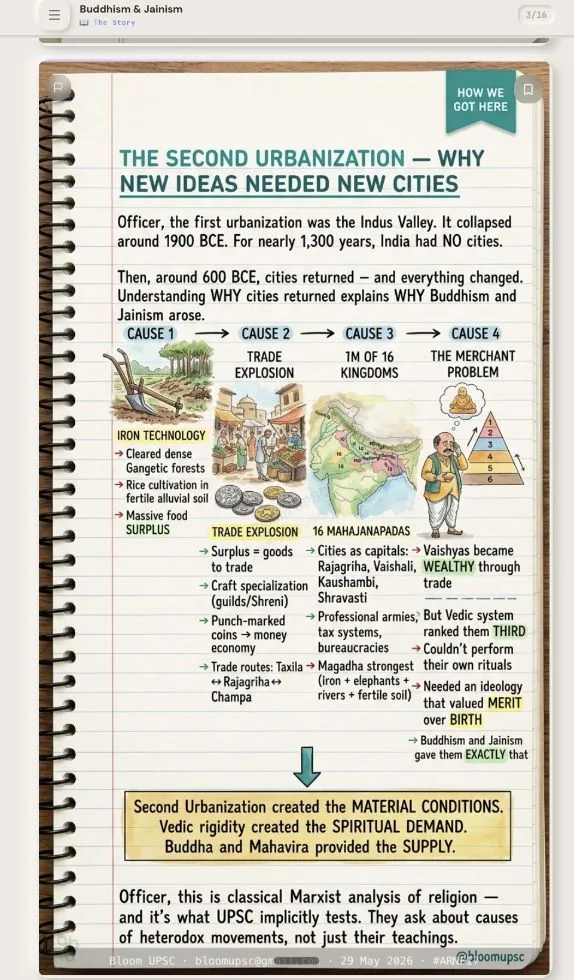
BLOOM note on the Second Urbanization, titled 'Why new ideas needed new cities', from the Buddhism and Jainism story.
Around 600 BCE cities returned in India after the Indus Valley collapse near 1900 BCE. The note names four causes: iron technology, a trade explosion, 16 Mahajanapadas and the merchant problem.
The trade cause includes craft guilds and punch-marked coins that created a money economy, with trade routes linking Taxila, Rajagriha and Champa. Cities served as capitals of the Mahajanapadas.
The UPSC question: GS Series D, Q13
The actual paper · GS Series D · Q13
The question, as text
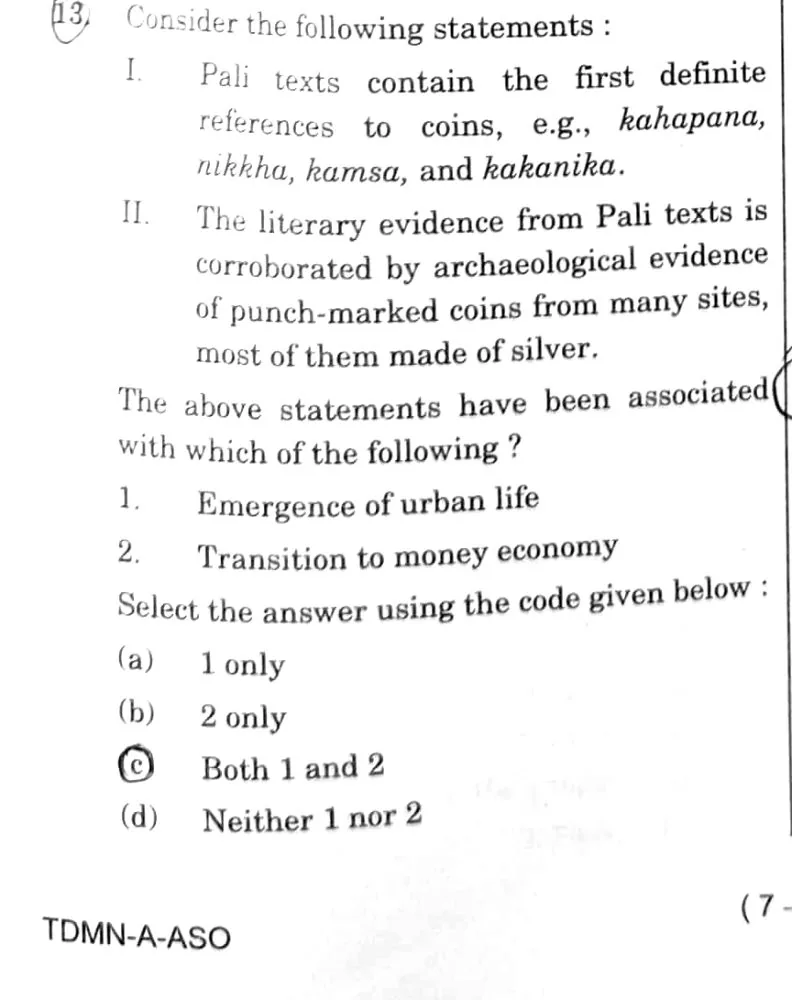
UPSC Prelims 2026, GS Series D, Q13. Consider the following statements :
I. Pali texts contain the first definite references to coins, e.g., kahapana, nikkha, kamsa, and kakanika.
II. The literary evidence from Pali texts is corroborated by archaeological evidence of punch-marked coins from many sites, most of them made of silver.
The above statements have been associated with which of the following ?
1. Emergence of urban life
2. Transition to money economy
Select the answer using the code given below : (a) 1 only (b) 2 only (c) Both 1 and 2 (d) Neither 1 nor 2
Geography · IR·UPSC Q91Topic covered05/28
India–ASEAN connectivity
Our note
We covered India–ASEAN connectivity. Came as UPSC Q91.
The note, as text
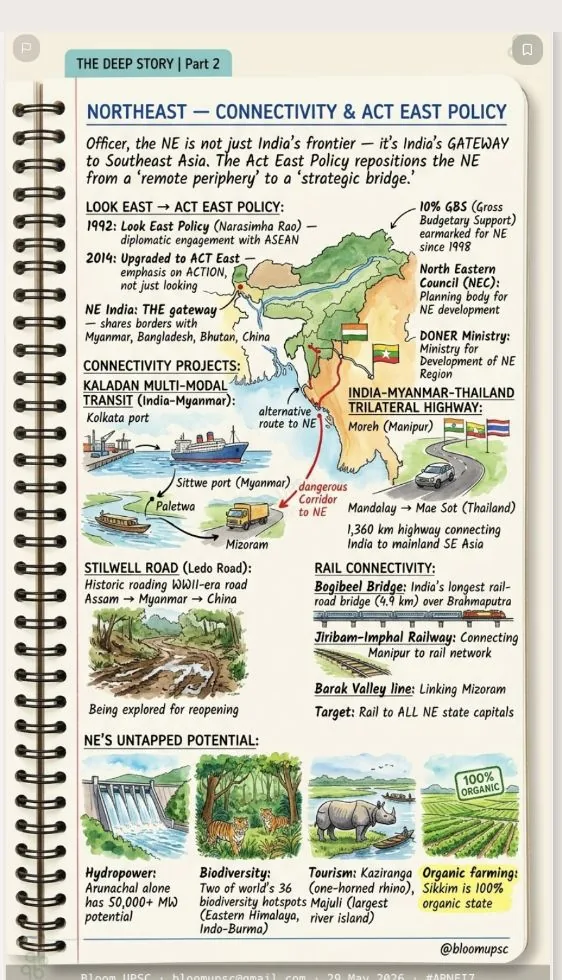
BLOOM note on Northeast India connectivity and the Act East Policy: the Northeast as India's gateway to Southeast Asia.
It lists the Kaladan Multi-Modal Transit (Kolkata port to Sittwe port in Myanmar, then Paletwa to Mizoram) and the India-Myanmar-Thailand Trilateral Highway from Moreh in Manipur to Mae Sot.
It also lists the Stilwell Road and rail links: Bogibeel Bridge, Jiribam-Imphal Railway and the Barak Valley line, with a target of rail to all Northeast state capitals.
The UPSC question: GS Series D, Q91
The actual paper · GS Series D · Q91
The question, as text
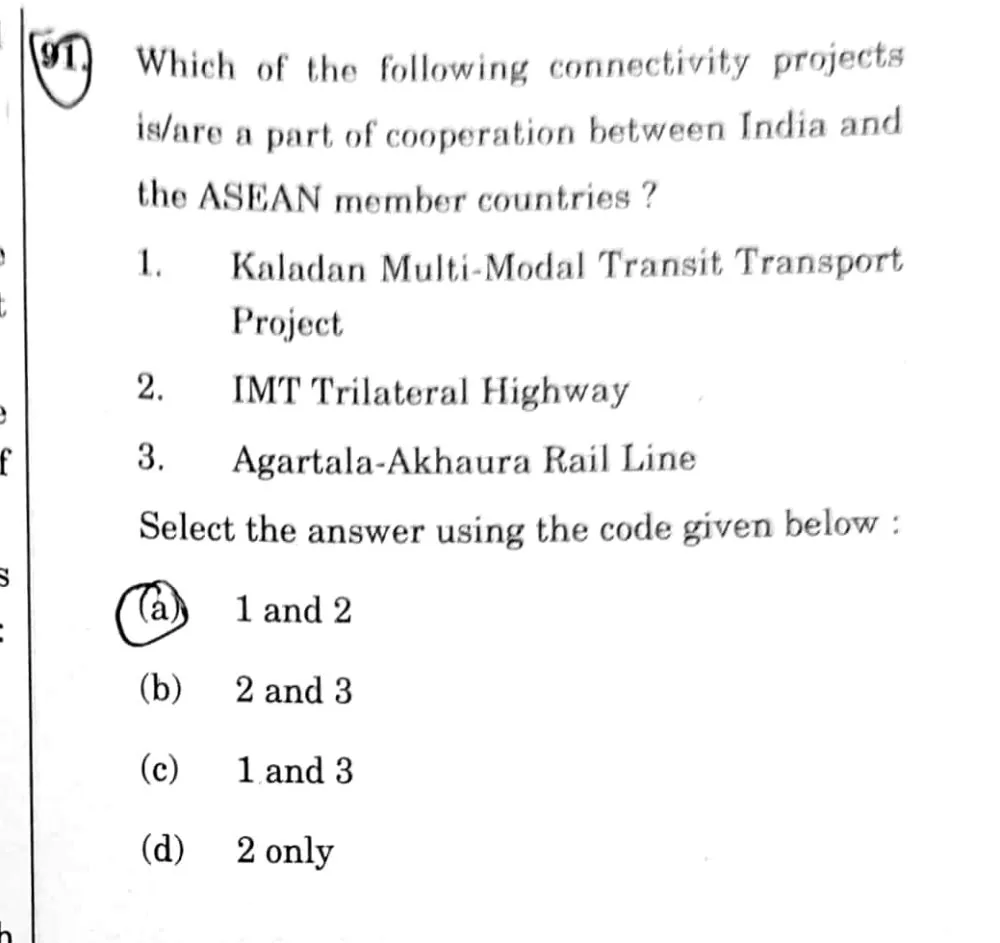
UPSC Prelims 2026, GS Series D, Q91. Which of the following connectivity projects is/are a part of cooperation between India and the ASEAN member countries ?
1. Kaladan Multi-Modal Transit Transport Project
2. IMT Trilateral Highway
3. Agartala-Akhaura Rail Line
Select the answer using the code given below : (a) 1 and 2 (b) 2 and 3 (c) 1 and 3 (d) 2 only
Geography·UPSC Q40Topic covered06/28
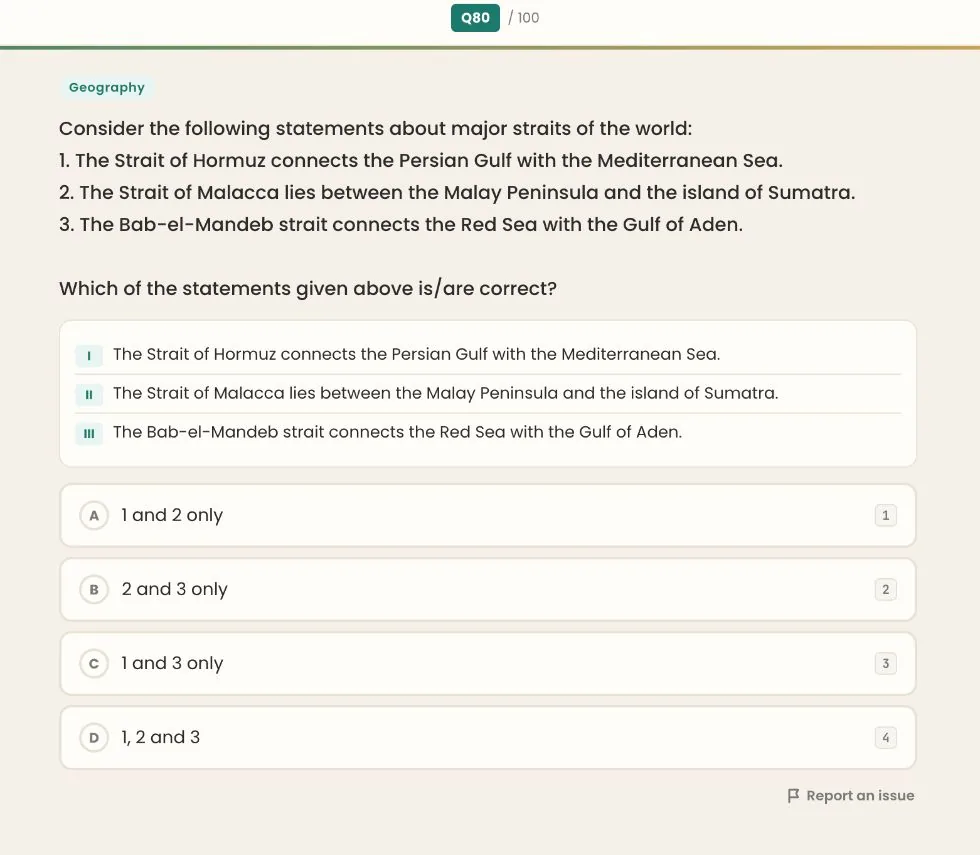
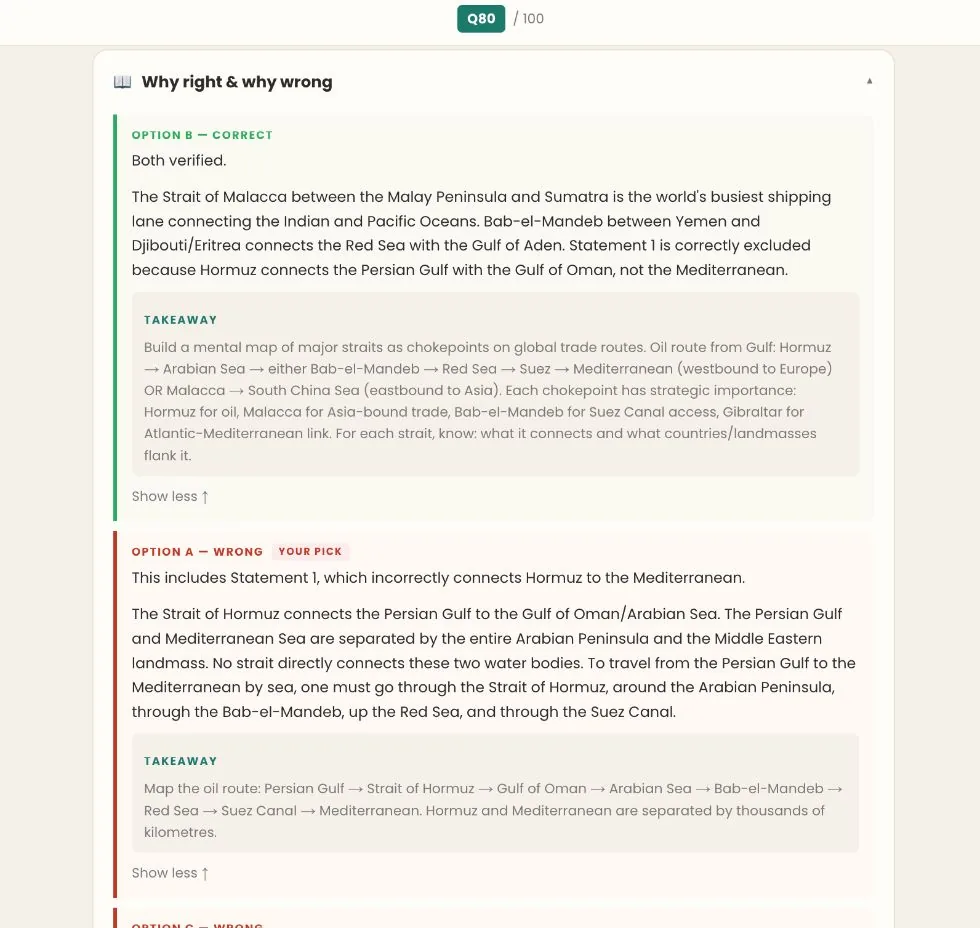
Major straits of the world
Our mock: the questionOur mock: the explanation
We drilled the major straits: Hormuz, Malacca and Bab-el-Mandeb, and exactly where each one connects. Came as UPSC Q40.
The note, as text
BLOOM mock question on major straits of the world, with a written explanation of why each statement is right or wrong.
The Strait of Hormuz connects the Persian Gulf with the Gulf of Oman and Arabian Sea, not the Mediterranean. Malacca lies between the Malay Peninsula and Sumatra.
Bab-el-Mandeb lies between Yemen and Djibouti/Eritrea and connects the Red Sea with the Gulf of Aden. The takeaway traces the oil route from the Persian Gulf through Hormuz, Bab-el-Mandeb and the Suez Canal to the Mediterranean.
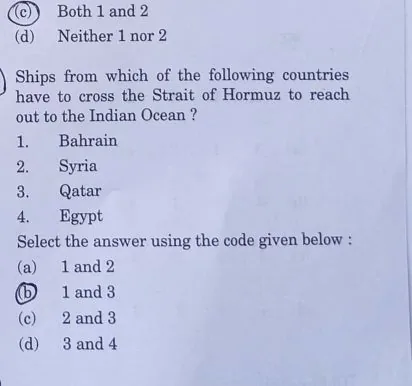
The UPSC question: GS Series D, Q40
The actual paper · GS Series D · Q40
The question, as text
UPSC Prelims 2026, GS Series D, Q40. Ships from which of the following countries have to cross the Strait of Hormuz to reach out to the Indian Ocean ?
1. Bahrain
2. Syria
3. Qatar
4. Egypt
Select the answer using the code given below : (a) 1 and 2 (b) 1 and 3 (c) 2 and 3 (d) 3 and 4. The question number is cut off at the left edge; the last two lines of the previous question appear above in this picture of the paper.
Ancient History·UPSC Q3Topic covered07/28
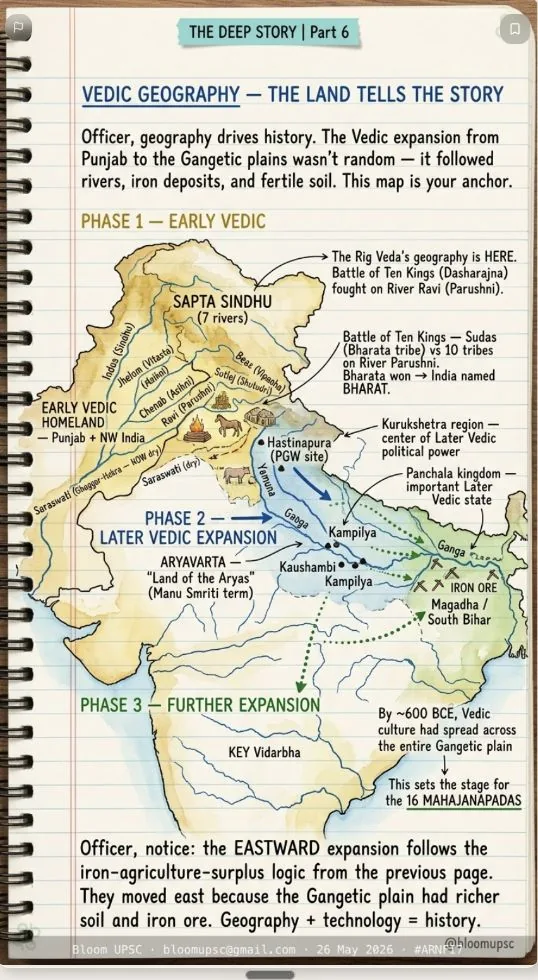
Ancient river names
Our note
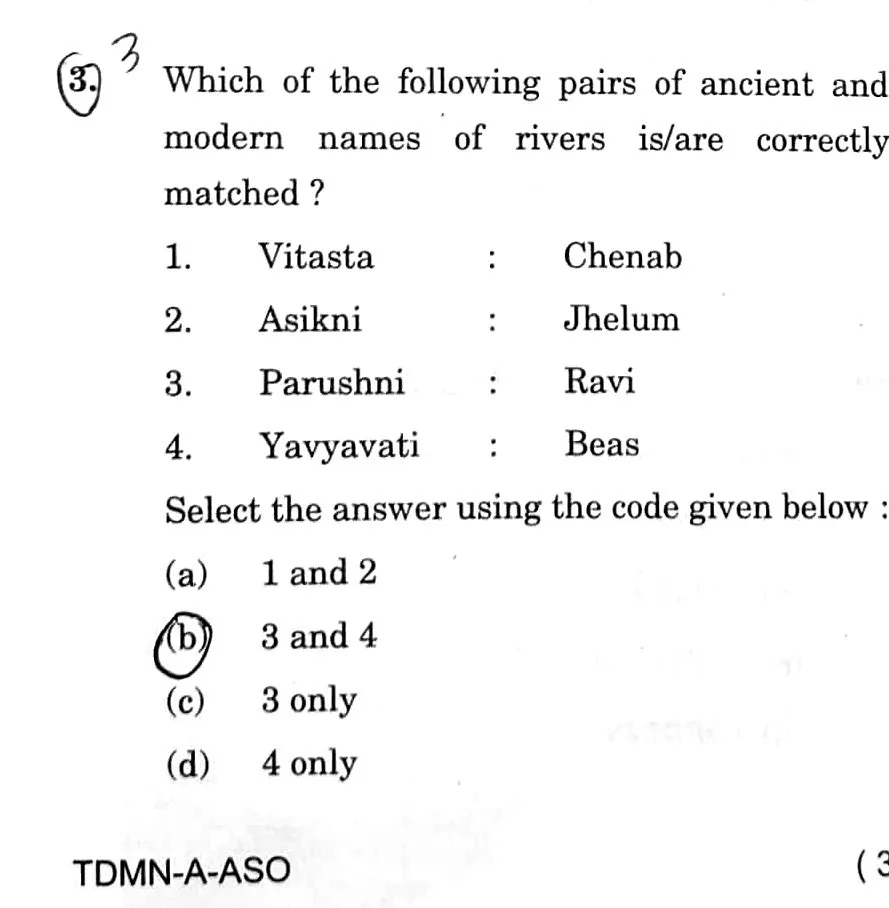
We covered the ancient river names. Came as UPSC Q3.
The note, as text
BLOOM note on Vedic geography, 'The land tells the story', with a map of the Early Vedic homeland, Sapta Sindhu (seven rivers), in Punjab and North-West India.
The map labels the rivers with ancient names in brackets: Indus (Sindhu), Jhelum (Vitasta), Chenab, Ravi (Parushni), Beas (Vipasha) and Sutlej (Shutudri), plus the dry Saraswati.
The Battle of Ten Kings, led by Sudas of the Bharata tribe, was fought on the River Ravi (Parushni). Later Vedic expansion moved east towards the Gangetic plains.
The UPSC question: GS Series D, Q3
The actual paper · GS Series D · Q3
The question, as text
UPSC Prelims 2026, GS Series D, Q3. Which of the following pairs of ancient and modern names of rivers is/are correctly matched ?
1. Vitasta : Chenab
2. Asikni : Jhelum
3. Parushni : Ravi
4. Yavyavati : Beas
Select the answer using the code given below : (a) 1 and 2 (b) 3 and 4 (c) 3 only (d) 4 only
Economy · Infra·UPSC Q25Topic covered08/28
Sagarmala
Our mockOur mock
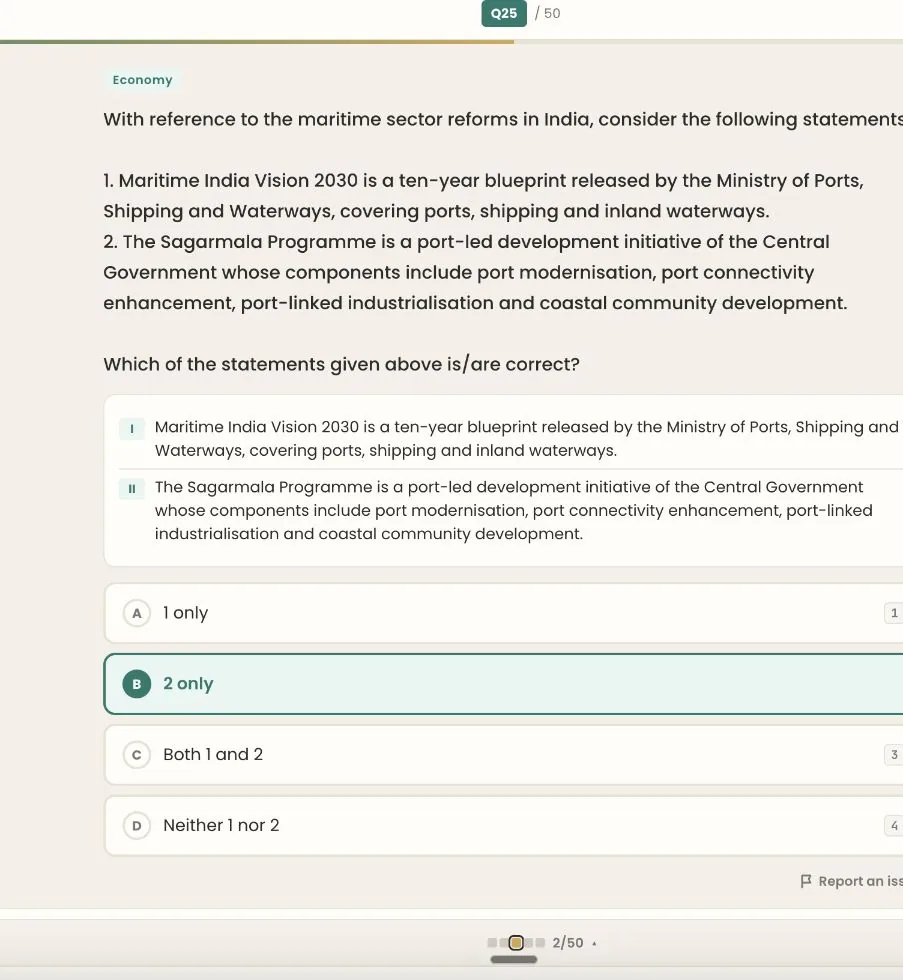
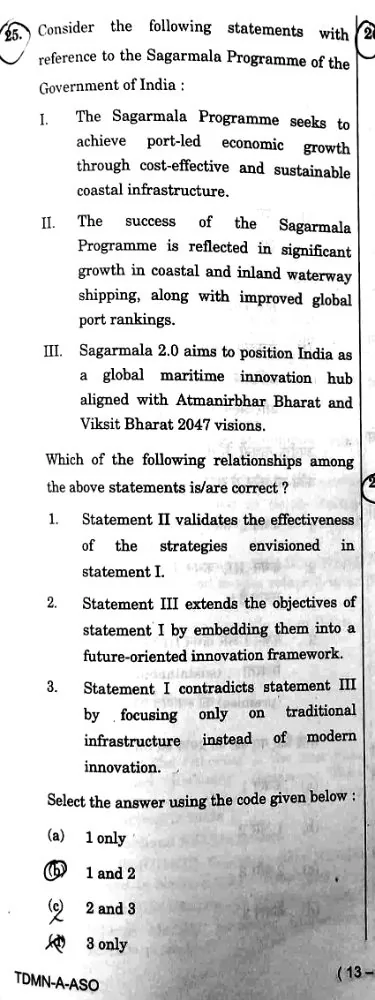
We covered Sagarmala. Came as UPSC Q25.
The note, as text
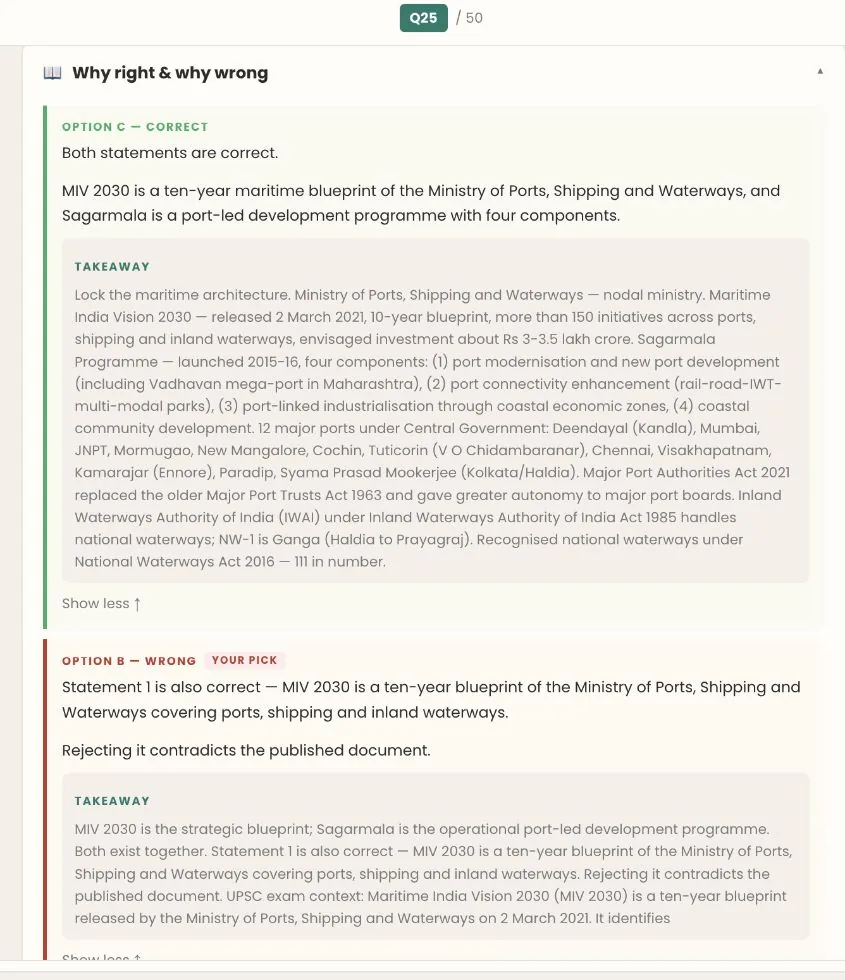
BLOOM mock question on maritime sector reforms in India, covering Maritime India Vision 2030 and the Sagarmala Programme, with a written explanation.
Maritime India Vision 2030 is a ten-year blueprint of the Ministry of Ports, Shipping and Waterways, released on 2 March 2021, with about 150 initiatives across ports, shipping and inland waterways.
Sagarmala was launched in 2015-16 with four components: port modernisation, port connectivity, port-linked industrialisation through coastal economic zones, and coastal community development.
The UPSC question: GS Series D, Q25
The actual paper · GS Series D · Q25
The question, as text
UPSC Prelims 2026, GS Series D, Q25. Consider the following statements with reference to the Sagarmala Programme of the Government of India :
I. The Sagarmala Programme seeks to achieve port-led economic growth through cost-effective and sustainable coastal infrastructure.
II. The success of the Sagarmala Programme is reflected in significant growth in coastal and inland waterway shipping, along with improved global port rankings.
III. Sagarmala 2.0 aims to position India as a global maritime innovation hub aligned with Atmanirbhar Bharat and Viksit Bharat 2047 visions.
Which of the following relationships among the above statements is/are correct ?
1. Statement II validates the effectiveness of the strategies envisioned in statement I.
2. Statement III extends the objectives of statement I by embedding them into a future-oriented innovation framework.
3. Statement I contradicts statement III by focusing only on traditional infrastructure instead of modern innovation.
Select the answer using the code given below : (a) 1 only (b) 1 and 2 (c) 2 and 3 (d) 3 only
Environment·UPSC Q33Covered09/28
Mangroves & climate resilience
Our noteOur noteOur mockOur mock
We covered mangroves as coastal bio-shields. Came as UPSC Q33.
The note, as text
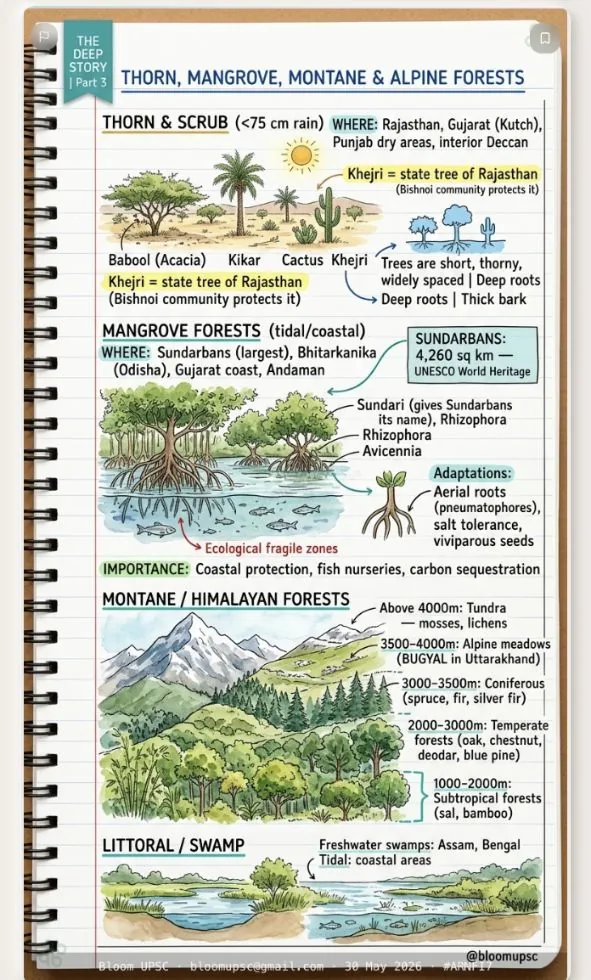
BLOOM note on mangrove forests: they grow in tidal and coastal areas, such as the Sundarbans, Bhitarkanika, the Gujarat coast and Andaman, with Sundari, Rhizophora and Avicennia trees.
Adaptations are aerial roots (pneumatophores), salt tolerance and viviparous seeds. Their importance is coastal protection, fish nurseries and carbon sequestration. The note calls them ecologically fragile zones.
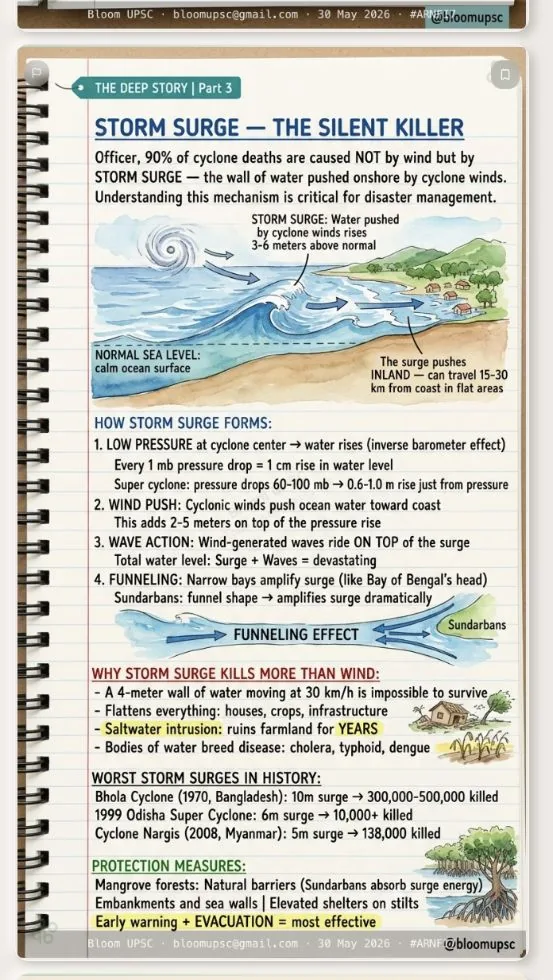
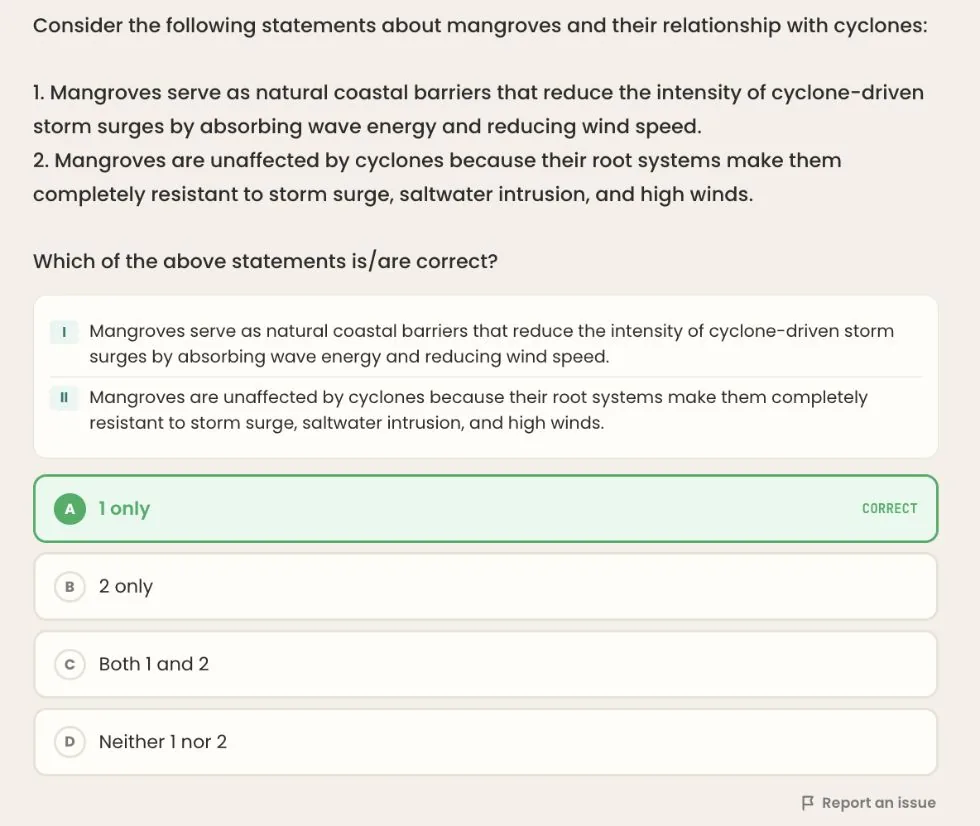
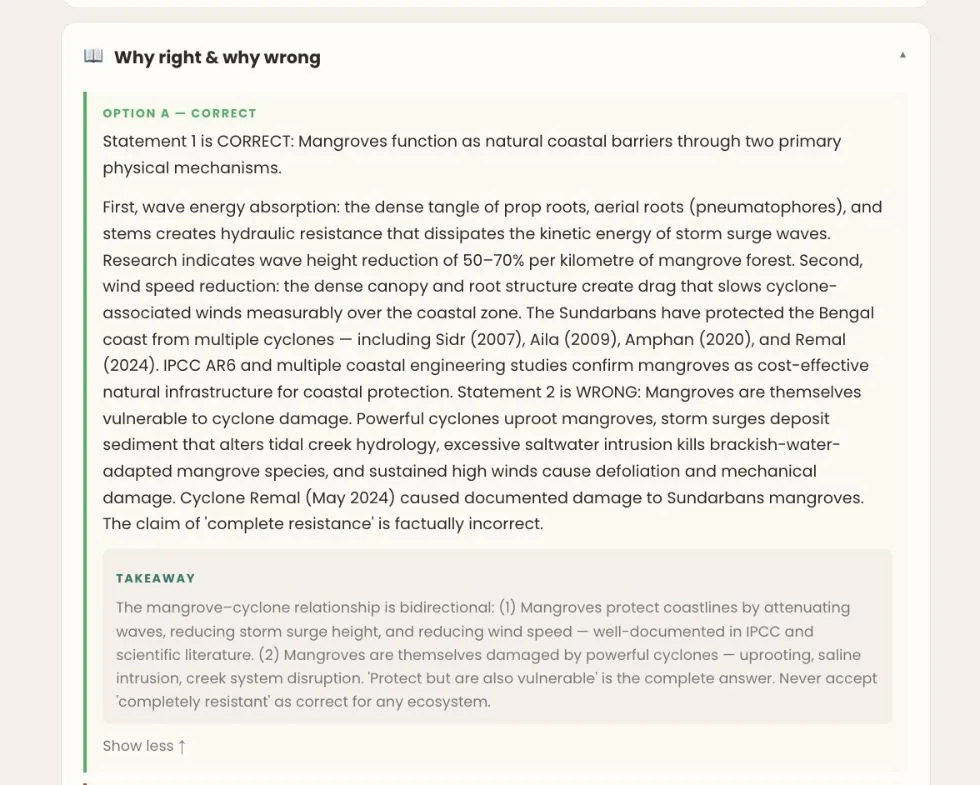
A second note on storm surge says mangrove forests act as natural barriers. A BLOOM mock question explains that mangroves reduce wave energy and wind speed but are themselves damaged by powerful cyclones.
The UPSC question: GS Series D, Q33
The actual paper · GS Series D · Q33
The question, as text
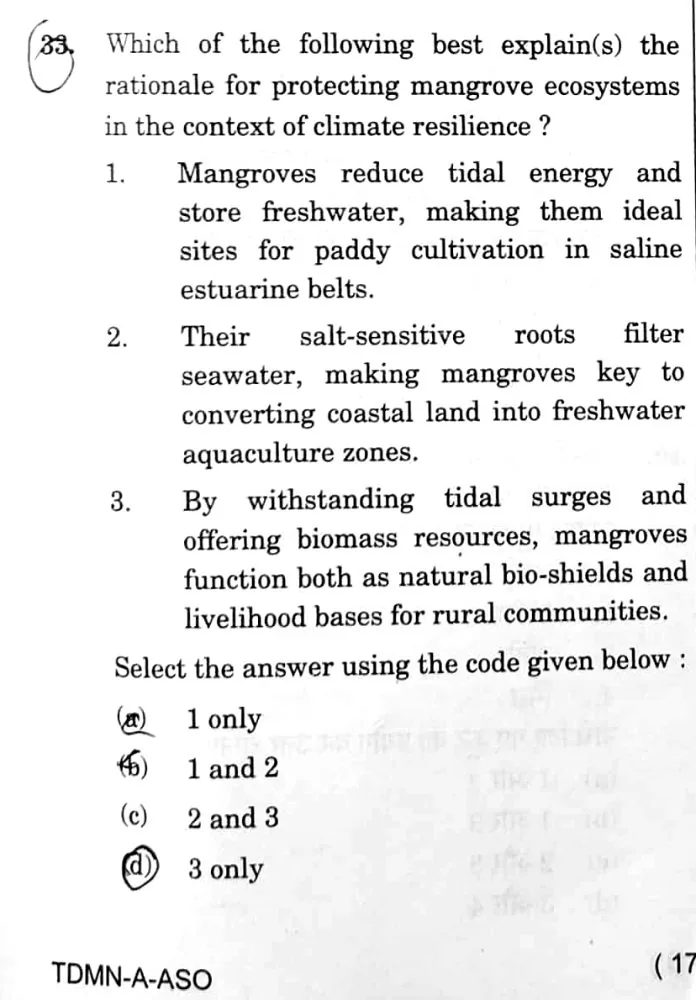
UPSC Prelims 2026, GS Series D, Q33. Which of the following best explain(s) the rationale for protecting mangrove ecosystems in the context of climate resilience ?
1. Mangroves reduce tidal energy and store freshwater, making them ideal sites for paddy cultivation in saline estuarine belts.
2. Their salt-sensitive roots filter seawater, making mangroves key to converting coastal land into freshwater aquaculture zones.
3. By withstanding tidal surges and offering biomass resources, mangroves function both as natural bio-shields and livelihood bases for rural communities.
Select the answer using the code given below : (a) 1 only (b) 1 and 2 (c) 2 and 3 (d) 3 only
Section 02 · 9 questions
Economy
Macro concepts, committees, digital public infrastructure and finance.
Economy·UPSC Q59Exact match10/28
Crowding Out Effect
Our note
Our note drew the exact chain: borrow → rates rise → investment falls. UPSC Q59 asked you to name it.
The note, as text
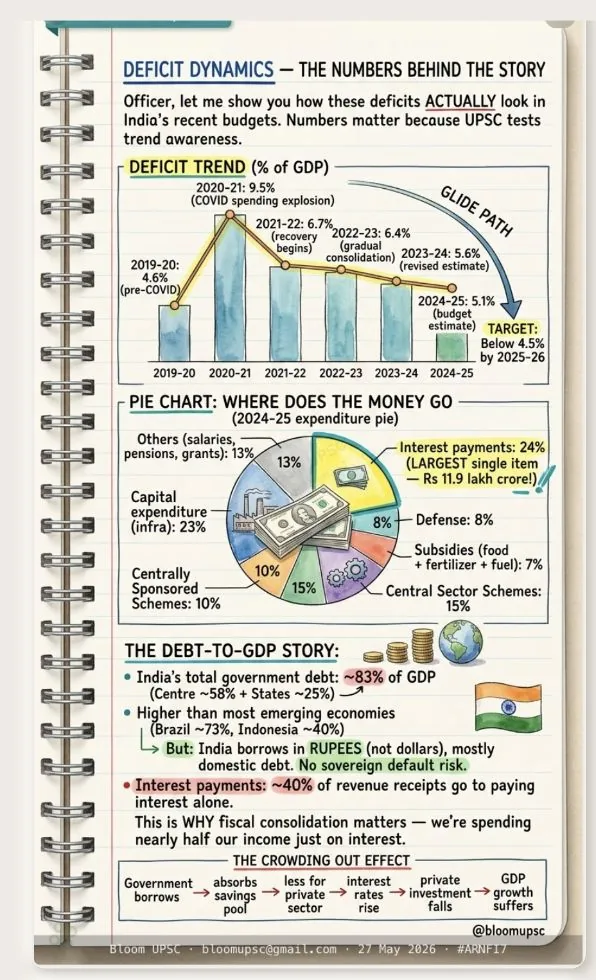
BLOOM note on India's deficit numbers: the deficit was 9.5% of GDP in 2020-21 and 5.1% in 2024-25 (budget estimate), with a target below 4.5% by 2025-26.
The note says interest payments are the largest single item of 2024-25 spending at 24%, and that about 40% of revenue receipts go to paying interest.
It ends with the crowding out effect as a chain: government borrows, absorbs savings, interest rates rise, private investment falls and GDP growth suffers.
The UPSC question: GS Series D, Q59
The actual paper · GS Series D · Q59
The question, as text
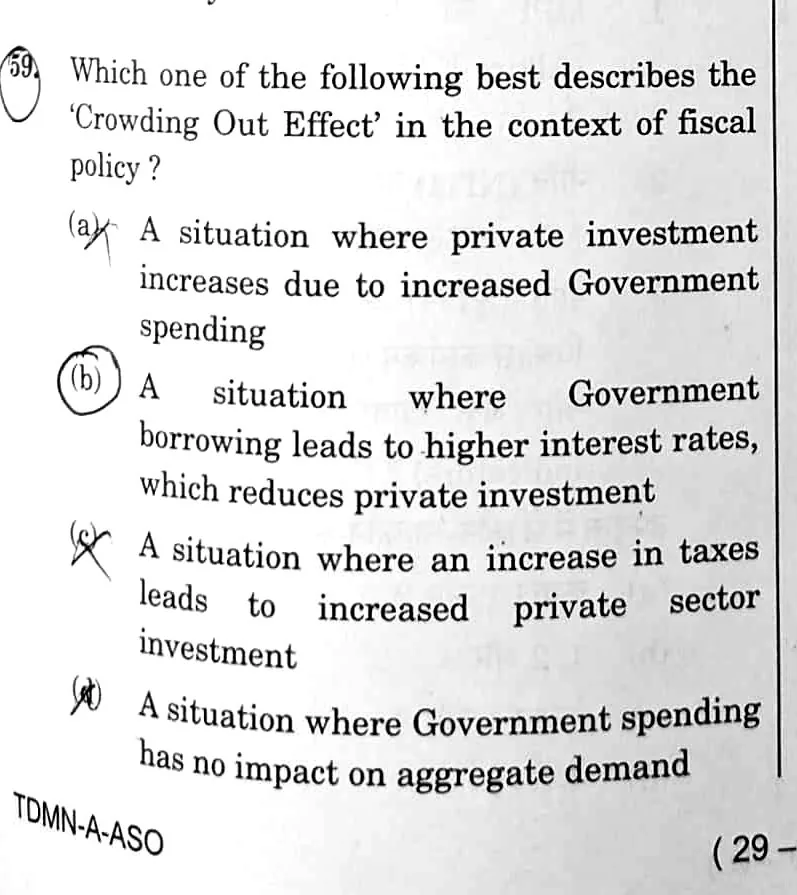
UPSC Prelims 2026, GS Series D, Q59. Which one of the following best describes 'Crowding Out Effect' in the context of fiscal policy ?
(a) A situation where private investment increases due to increased Government spending (b) A situation where Government borrowing leads to higher interest rates, which reduces private investment (c) A situation where an increase in taxes leads to increased private sector investment (d) A situation where Government spending has no impact on aggregate demand
Economy·UPSC Q63Topic covered11/28
Economic Committees
Our noteOur note
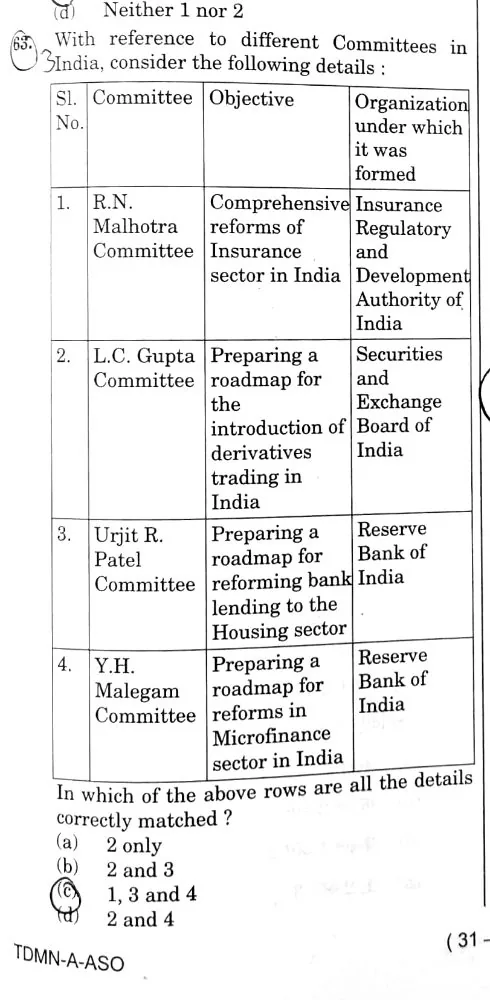
We covered the committees. Came as UPSC Q63.
The note, as text
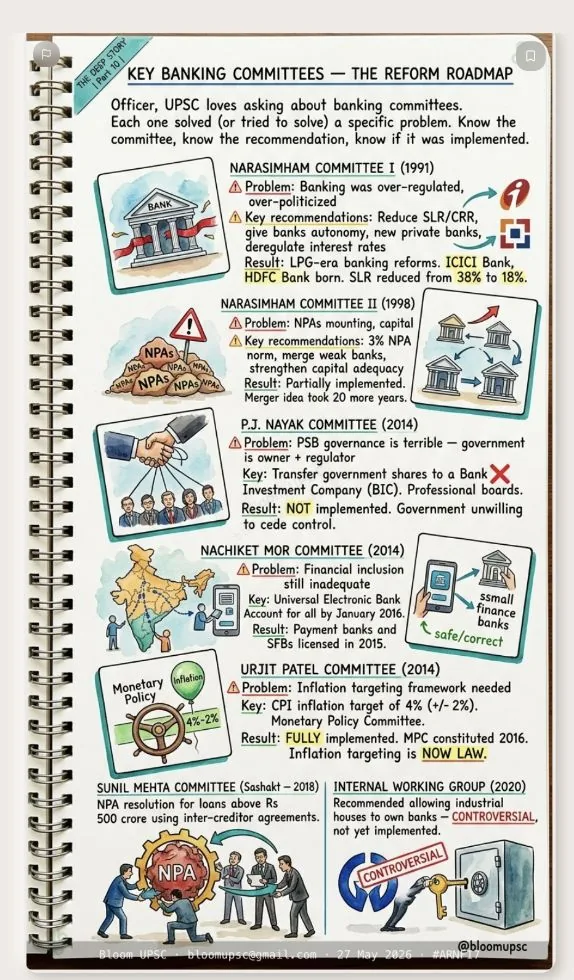
BLOOM note on key banking committees: Narasimham I (1991) and II (1998), P.J. Nayak (2014), Nachiket Mor (2014), Urjit Patel (2014), Sunil Mehta (2018) and the Internal Working Group (2020).
It lists the Urjit Patel Committee (2014) as the one that recommended a CPI inflation target of 4% (+/- 2%) and a Monetary Policy Committee, which was constituted in 2016.
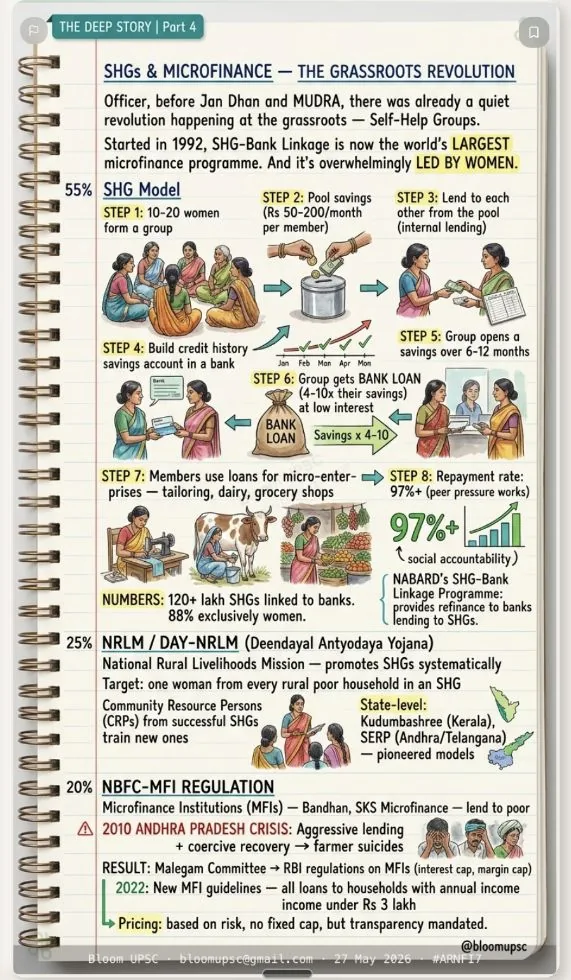
A second BLOOM note, on self-help groups, says the Malegam Committee led to RBI regulations on microfinance institutions after the 2010 Andhra Pradesh crisis.
The UPSC question: GS Series D, Q63
The actual paper · GS Series D · Q63
The question, as text
UPSC Prelims 2026, GS Series D, Q63. With reference to different Committees in India, consider the following details :
1. R.N. Malhotra Committee | Comprehensive reforms of Insurance sector in India | Insurance Regulatory and Development Authority of India
2. L.C. Gupta Committee | Preparing a roadmap for the introduction of derivatives trading in India | Securities and Exchange Board of India
3. Urjit R. Patel Committee | Preparing a roadmap for reforming bank lending to the Housing sector | Reserve Bank of India
4. Y.H. Malegam Committee | Preparing a roadmap for reforms in Microfinance sector in India | Reserve Bank of India
In which of the above rows are all the details correctly matched ? (a) 2 only (b) 2 and 3 (c) 1, 3 and 4 (d) 2 and 4
Economy·UPSC Q65Covered12/28
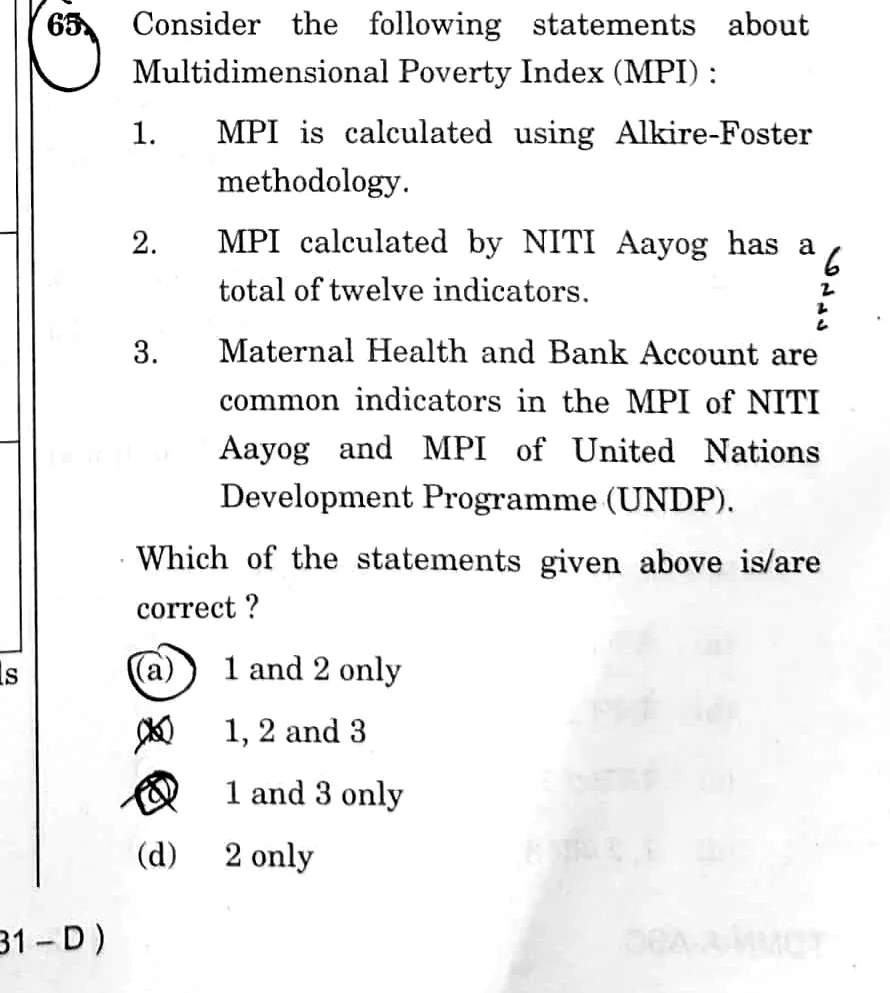
Multidimensional Poverty Index
Our mockOur mock
We covered the MPI. Came as UPSC Q65.
The note, as text
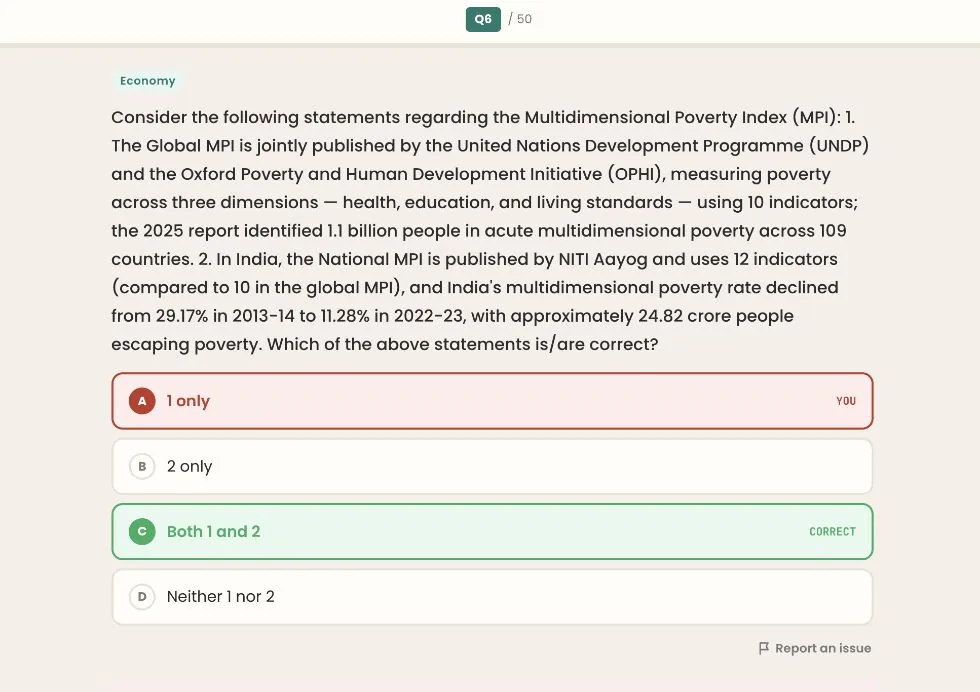
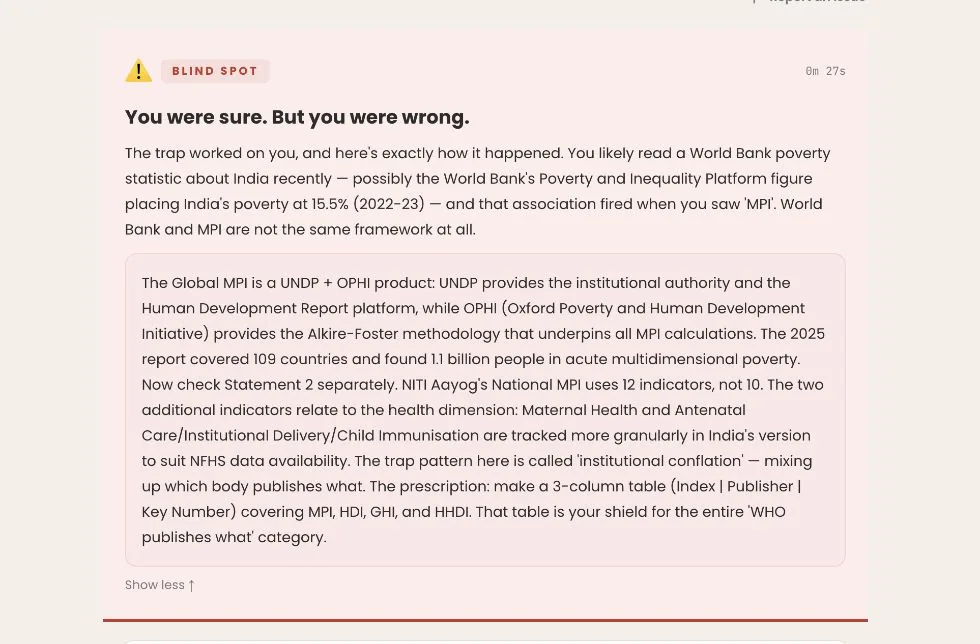
BLOOM mock question on the Multidimensional Poverty Index (MPI): the Global MPI is published jointly by UNDP and OPHI and uses 10 indicators across health, education and living standards.
The explanation says the 2025 Global MPI report covered 109 countries and found 1.1 billion people in acute multidimensional poverty, and that OPHI provides the Alkire-Foster methodology.
It adds that India's National MPI, published by NITI Aayog, uses 12 indicators and not 10, and that mixing up which body publishes which index is the trap.
The UPSC question: GS Series D, Q65
The actual paper · GS Series D · Q65
The question, as text
UPSC Prelims 2026, GS Series D, Q65. Consider the following statements about Multidimensional Poverty Index (MPI) :
1. MPI is calculated using Alkire-Foster methodology.
2. MPI calculated by NITI Aayog has a total of twelve indicators.
3. Maternal Health and Bank Account are common indicators in the MPI of NITI Aayog and MPI of United Nations Development Programme (UNDP).
Which of the statements given above is/are correct ? (a) 1 and 2 only (b) 1, 2 and 3 (c) 1 and 3 only (d) 2 only
Economy·UPSC Q48Topic covered13/28
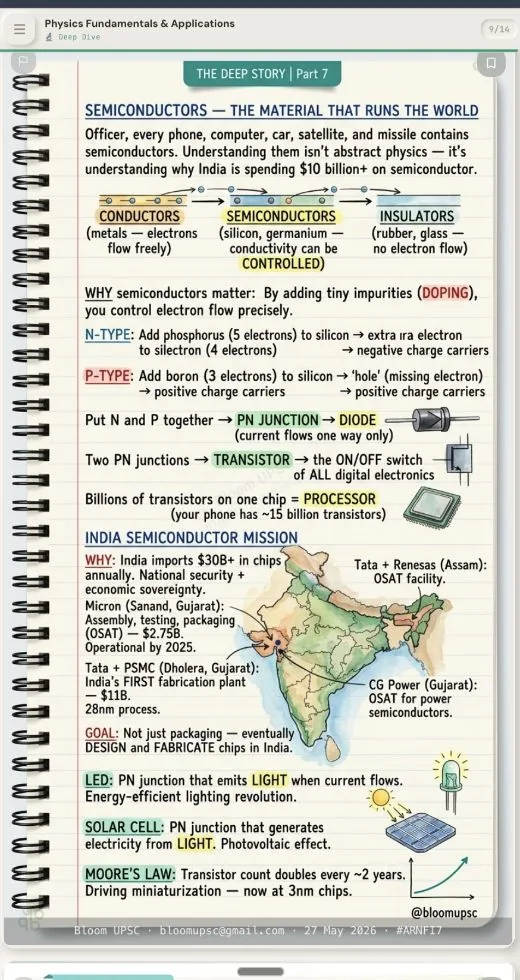
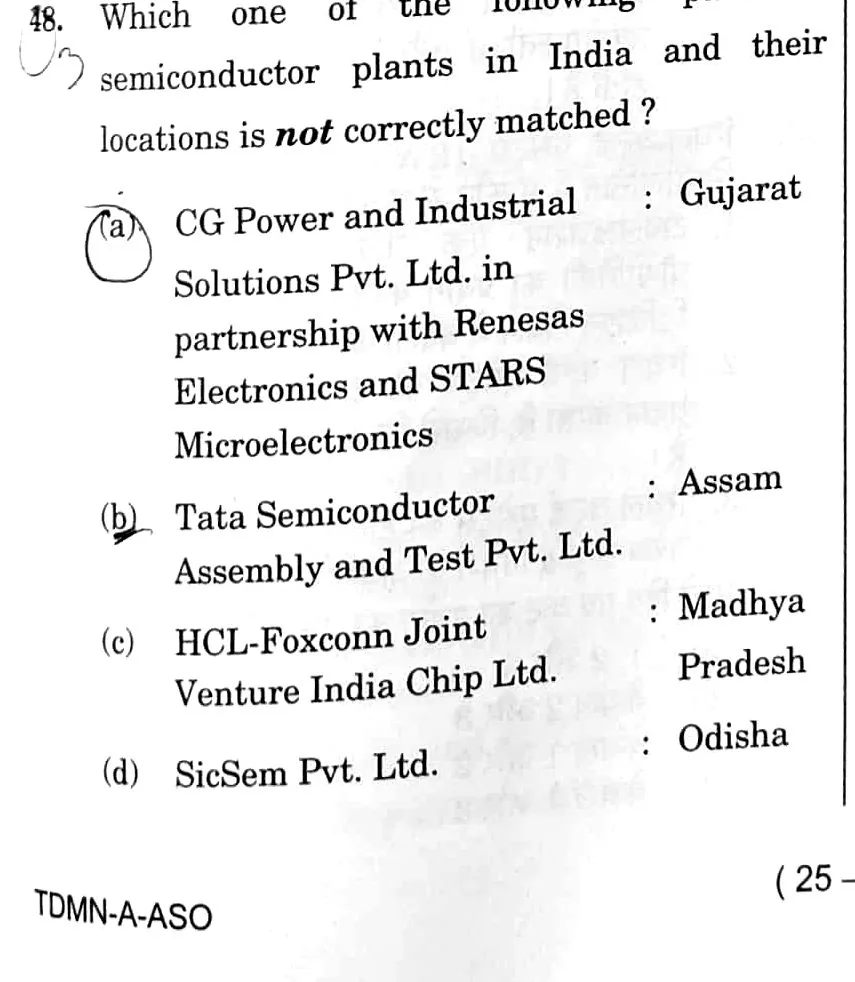
Semiconductor plants
Our note
We covered India’s semiconductor plants. Came as UPSC Q48.
The note, as text
BLOOM note on semiconductors and the India Semiconductor Mission: Micron at Sanand, Gujarat is an assembly, testing and packaging (OSAT) plant worth $2.75B, operational by 2025.
Tata with PSMC at Dholera, Gujarat is called India's first fabrication plant, worth $11B on a 28nm process. CG Power in Gujarat is listed as an OSAT plant for power semiconductors.
The note also lists an OSAT facility in Assam under Tata, and says the goal is to eventually design and fabricate chips in India, not only package them.
The UPSC question: GS Series D, Q48
The actual paper · GS Series D · Q48
The question, as text
UPSC Prelims 2026, GS Series D, Q48. Which one of the following p... semiconductor plants in India and their locations is not correctly matched ?
(a) CG Power and Industrial Solutions Pvt. Ltd. in partnership with Renesas Electronics and STARS Microelectronics : Gujarat (b) Tata Semiconductor Assembly and Test Pvt. Ltd. : Assam (c) HCL-Foxconn Joint Venture India Chip Ltd. : Madhya Pradesh (d) SicSem Pvt. Ltd. : Odisha. The top of the first line is clipped, so the word after 'following' is not fully visible in this picture of the paper.
Economy·UPSC Q60Topic covered14/28
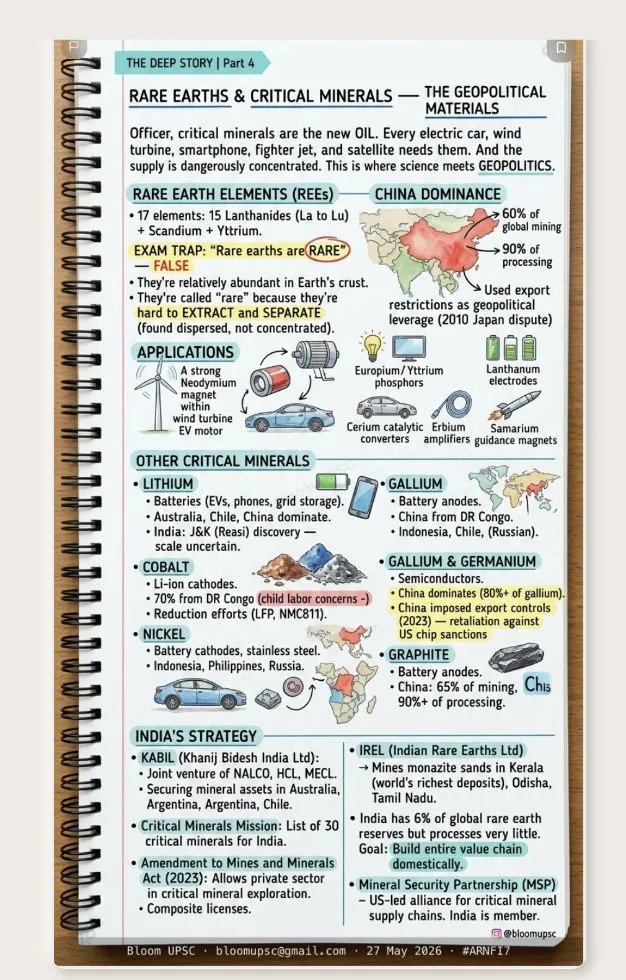
Rare Earths & critical minerals
Our noteOur note
We covered Rare Earths & the critical-minerals push. Came as UPSC Q60.
The note, as text
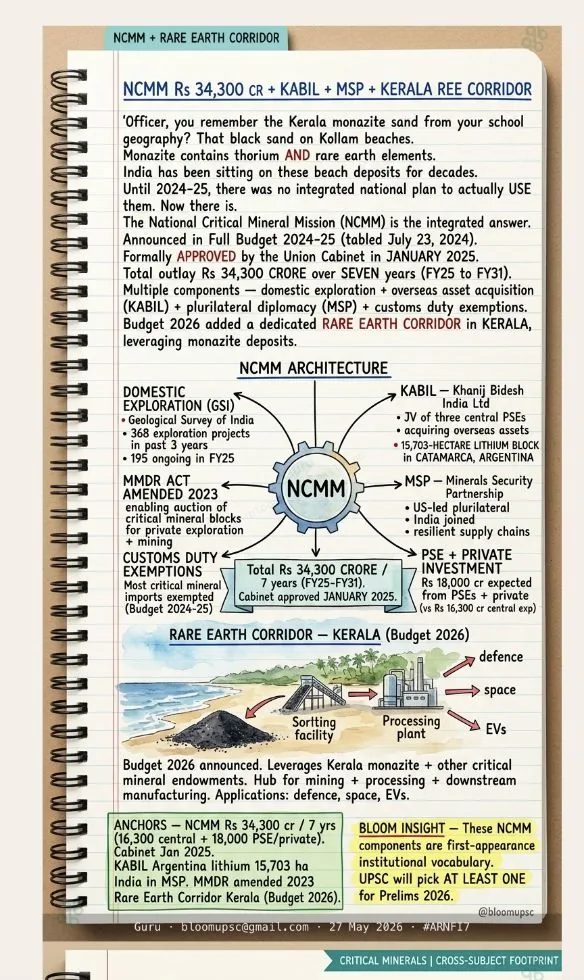
BLOOM note on rare earths and critical minerals: 17 elements (15 lanthanides plus scandium and yttrium). They are called 'rare' because they are hard to extract and separate, not because they are scarce in the crust.
The note says China has 60% of global mining and 90% of processing, India has 6% of reserves, and IREL mines monazite sands in Kerala, Odisha and Tamil Nadu.
A second note says the National Critical Mineral Mission has an outlay of Rs 34,300 crore over seven years, announced in Budget 2024-25 and approved by the Cabinet in January 2025.
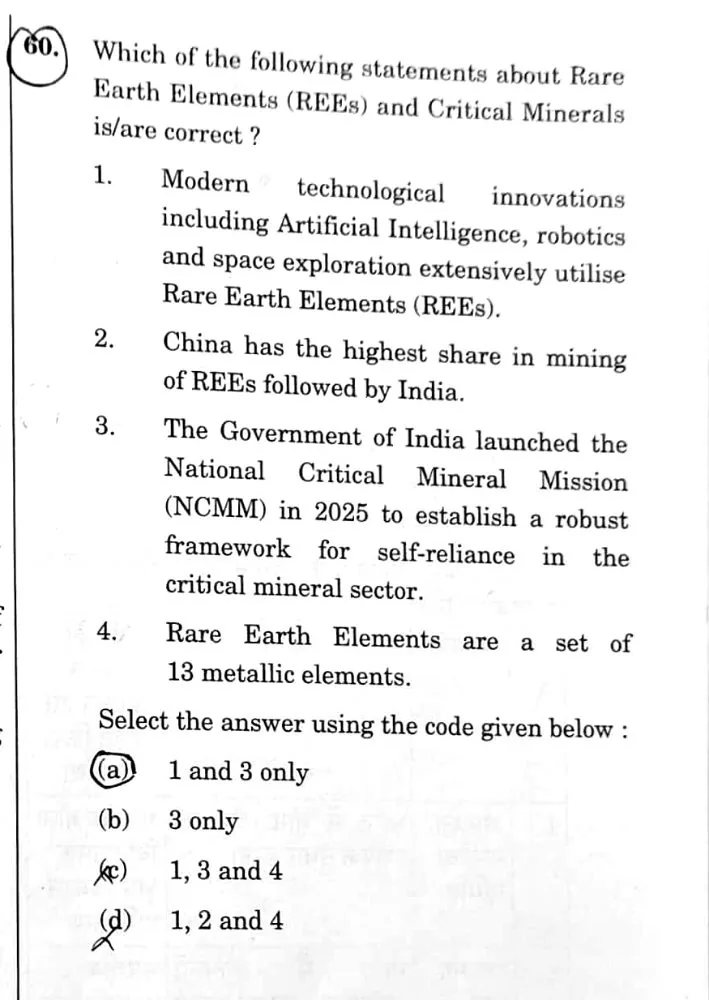
The UPSC question: GS Series D, Q60
The actual paper · GS Series D · Q60
The question, as text
UPSC Prelims 2026, GS Series D, Q60. Which of the following statements about Rare Earth Elements (REEs) and Critical Minerals is/are correct ?
1. Modern technological innovations including Artificial Intelligence, robotics and space exploration extensively utilise Rare Earth Elements (REEs).
2. China has the highest share in mining of REEs followed by India.
3. The Government of India launched the National Critical Mineral Mission (NCMM) in 2025 to establish a robust framework for self-reliance in the critical mineral sector.
4. Rare Earth Elements are a set of 13 metallic elements.
Select the answer using the code given below : (a) 1 and 3 only (b) 3 only (c) 1, 3 and 4 (d) 1, 2 and 4
Economy·UPSC Q54Covered15/28
ONDC
Our note
We covered ONDC. Came as UPSC Q54.
The note, as text
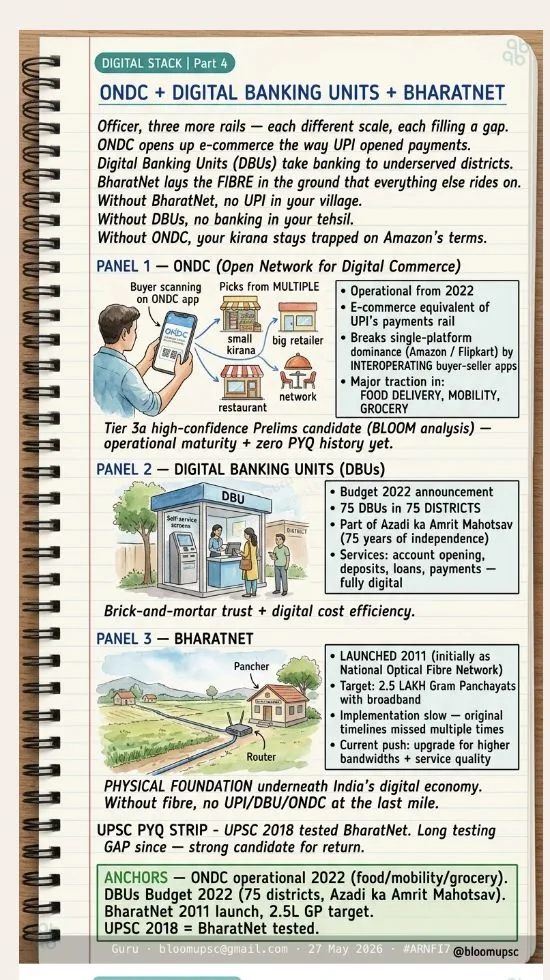
BLOOM note on ONDC (Open Network for Digital Commerce): it is called the e-commerce equivalent of UPI's payments rail, and it has been operational since 2022.
The note says it breaks single-platform dominance (Amazon, Flipkart) by letting buyer and seller apps interoperate, so a buyer can pick from many sellers such as a small kirana, a big retailer or a restaurant.
Traction so far is in food delivery, mobility and grocery. The same page also covers Digital Banking Units (75 in 75 districts) and BharatNet (launched 2011).
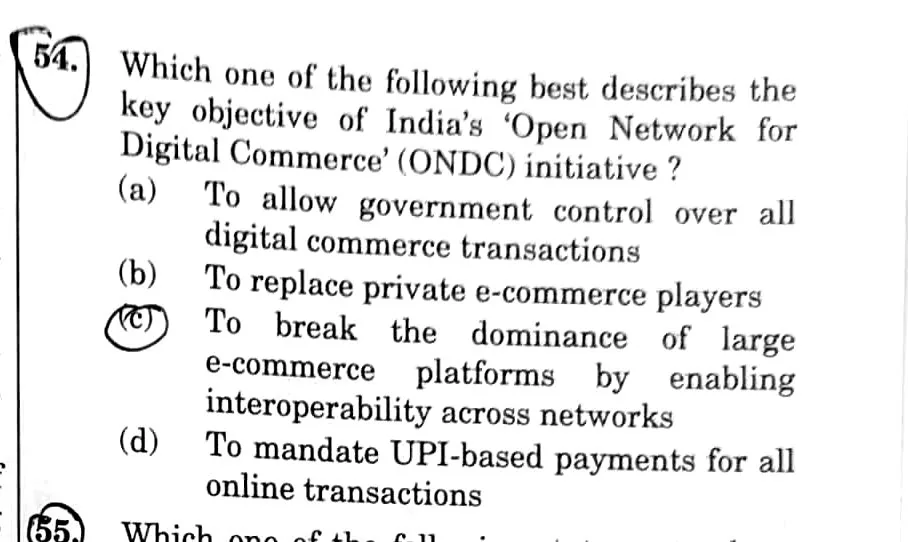
The UPSC question: GS Series D, Q54
The actual paper · GS Series D · Q54
The question, as text
UPSC Prelims 2026, GS Series D, Q54. Which one of the following best describes the key objective of India's 'Open Network for Digital Commerce' (ONDC) initiative ?
(a) To allow government control over all digital commerce transactions (b) To replace private e-commerce players (c) To break the dominance of large e-commerce platforms by enabling interoperability across networks (d) To mandate UPI-based payments for all online transactions
Economy·UPSC Q55Topic covered16/28
UPI & the Digital Rupee
Our note
We covered UPI & the Digital Rupee. Came as UPSC Q55.
The note, as text
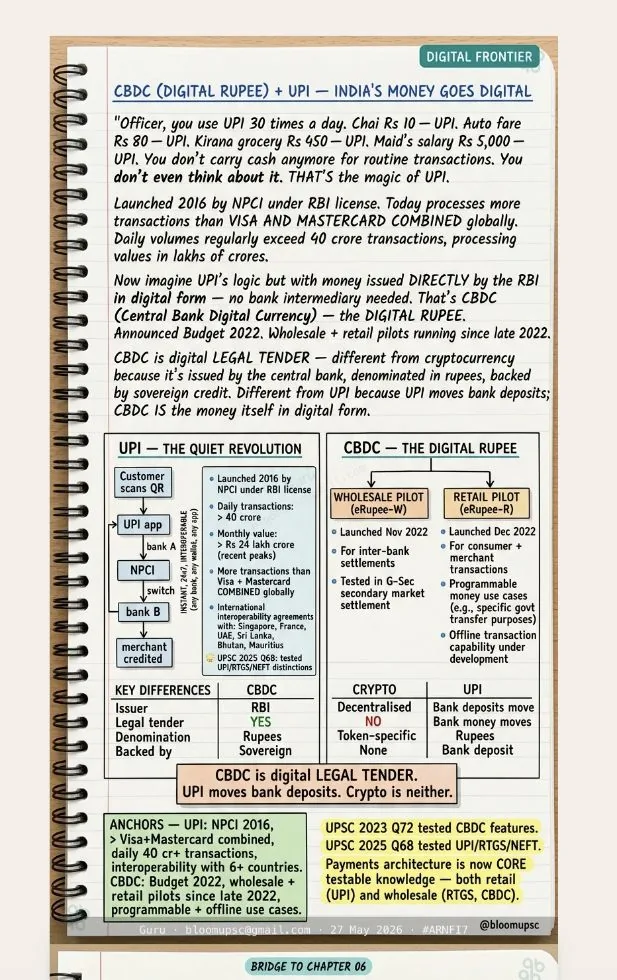
BLOOM note on UPI and the Digital Rupee: UPI was launched in 2016 by NPCI under an RBI licence, and it moves money between bank deposits.
CBDC (the Digital Rupee) is issued by the RBI, is legal tender, is denominated in rupees and is backed by sovereign credit. It was announced in Budget 2022.
The note lists a wholesale pilot (eRupee-W, November 2022) and a retail pilot (eRupee-R, December 2022), and says crypto is neither legal tender nor issued by a central bank.
The UPSC question: GS Series D, Q55
The actual paper · GS Series D · Q55
The question, as text
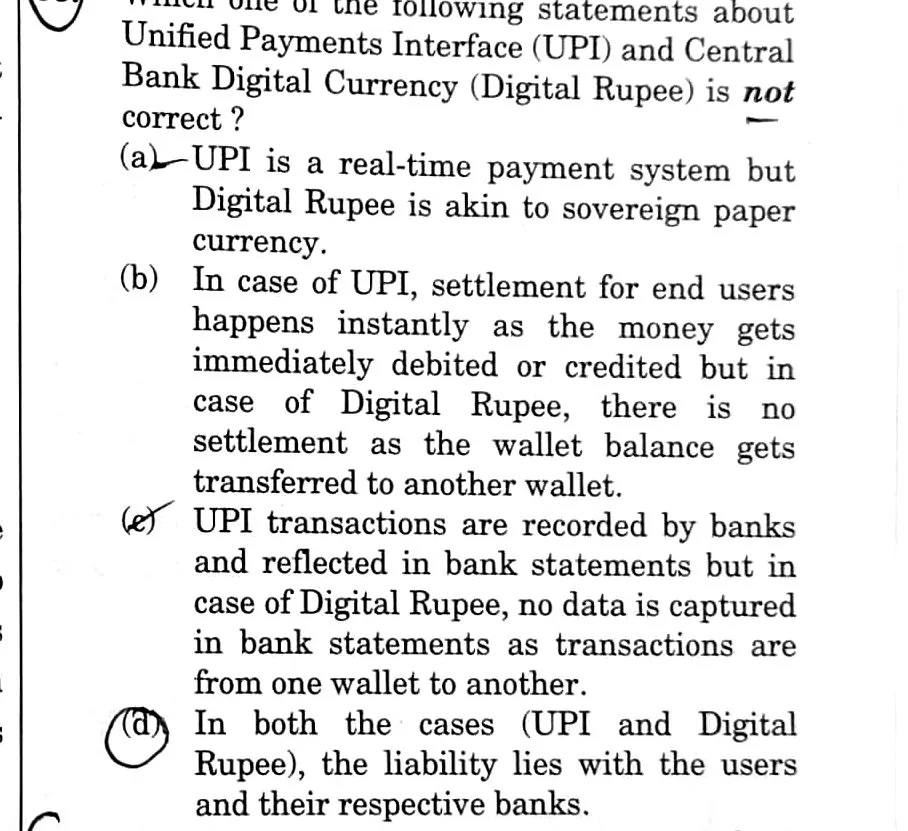
UPSC Prelims 2026, GS Series D, Q55. Which one of the following statements about Unified Payments Interface (UPI) and Central Bank Digital Currency (Digital Rupee) is not correct ?
(a) UPI is a real-time payment system but Digital Rupee is akin to sovereign paper currency. (b) In case of UPI, settlement for end users happens instantly as the money gets immediately debited or credited but in case of Digital Rupee, there is no settlement as the wallet balance gets transferred to another wallet. (c) UPI transactions are recorded by banks and reflected in bank statements but in case of Digital Rupee, no data is captured in bank statements as transactions are from one wallet to another. (d) In both the cases (UPI and Digital Rupee), the liability lies with the users and their respective banks.. The question number and the top edge of the first line are clipped in this picture of the paper.
Economy·UPSC Q64Topic covered17/28
NBFCs
Our note
We covered NBFCs. Came as UPSC Q64.
The note, as text
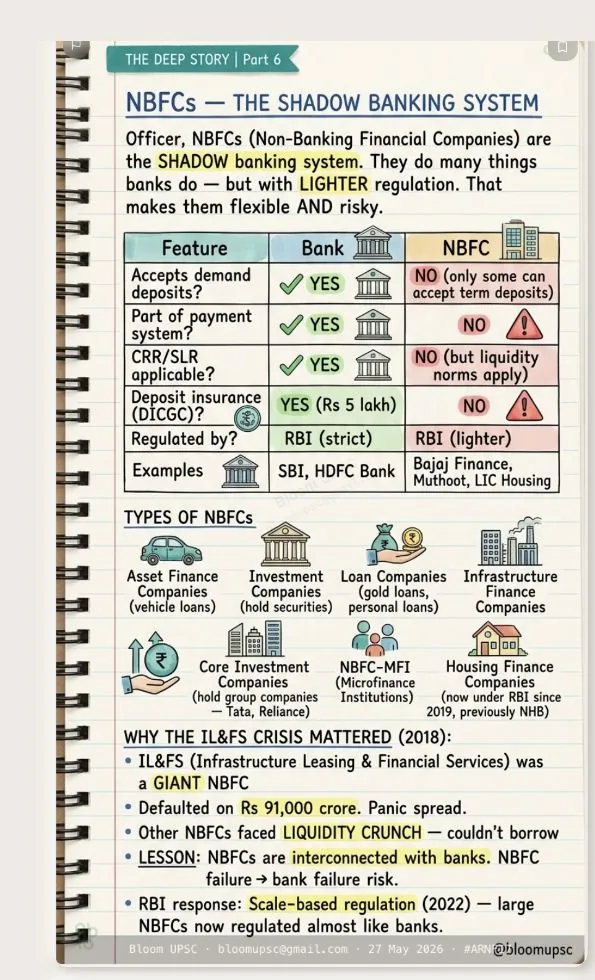
BLOOM note on NBFCs, the shadow banking system: they do many tasks banks do, but under lighter RBI regulation, so they are flexible and risky.
A comparison table says NBFCs cannot accept demand deposits (only some take term deposits), are not part of the payment system, and have no CRR or SLR.
The same table says NBFC depositors have no DICGC cover, unlike bank depositors (Rs 5 lakh). The note also covers the 2018 IL&S crisis and 2022 scale-based regulation.
The UPSC question: GS Series D, Q64
The actual paper · GS Series D · Q64
The question, as text
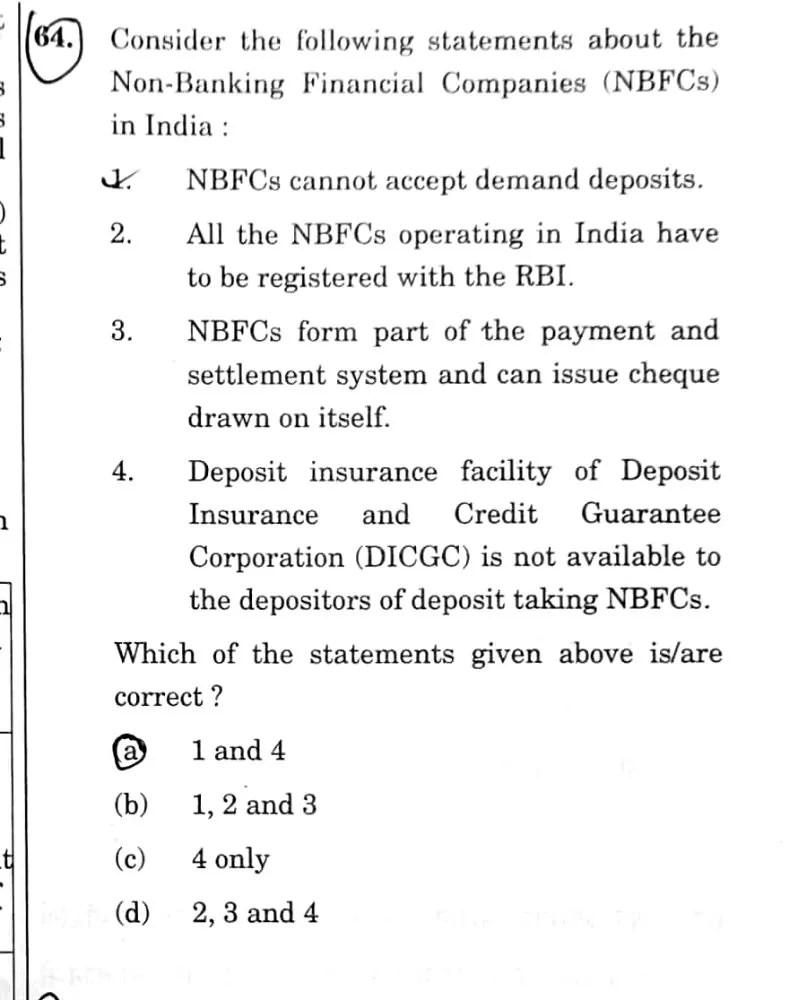
UPSC Prelims 2026, GS Series D, Q64. Consider the following statements about the Non-Banking Financial Companies (NBFCs) in India :
1. NBFCs cannot accept demand deposits.
2. All the NBFCs operating in India have to be registered with the RBI.
3. NBFCs form part of the payment and settlement system and can issue cheque drawn on itself.
4. Deposit insurance facility of Deposit Insurance and Credit Guarantee Corporation (DICGC) is not available to the depositors of deposit taking NBFCs.
Which of the statements given above is/are correct ? (a) 1 and 4 (b) 1, 2 and 3 (c) 4 only (d) 2, 3 and 4
Economy·UPSC Q53Exact match18/28
FI-Index sub-indices
Our noteOur mock
Our mock said “Access, Usage, Quality.” That was UPSC Q53’s answer, word for word.
The note, as text
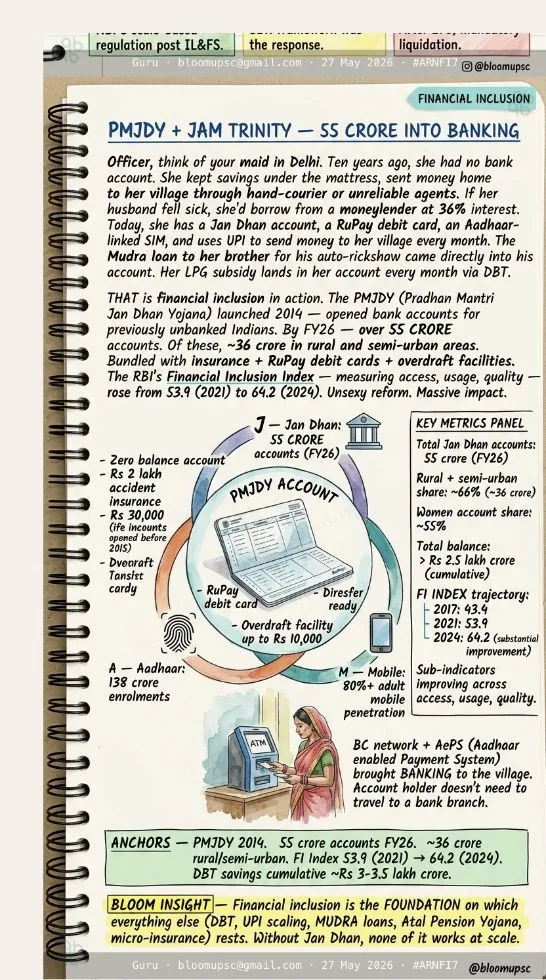
BLOOM note on PMJDY and the JAM trinity (Jan Dhan, Aadhaar, Mobile): the RBI Financial Inclusion Index measures access, usage and quality.
The note says the Index rose from 53.9 in 2021 to 64.2 in 2024, lists 2017 as 43.4, and says sub-indicators improved across access, usage and quality.
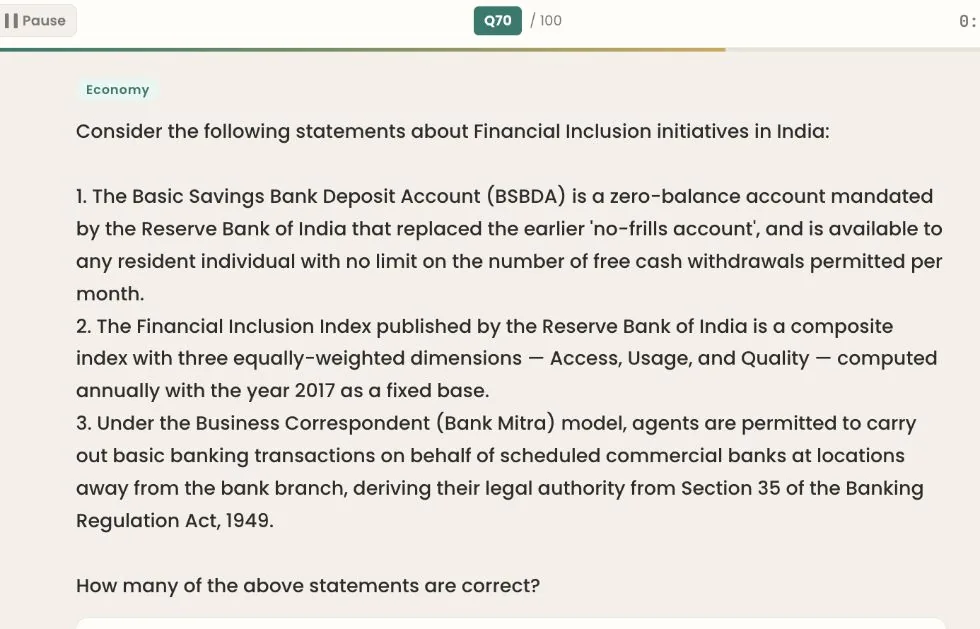
BLOOM mock question on financial inclusion: one statement calls the RBI Financial Inclusion Index a composite of three dimensions, Access, Usage and Quality, with 2017 as base year.
The UPSC question: GS Series D, Q53
The actual paper · GS Series D · Q53
The question, as text
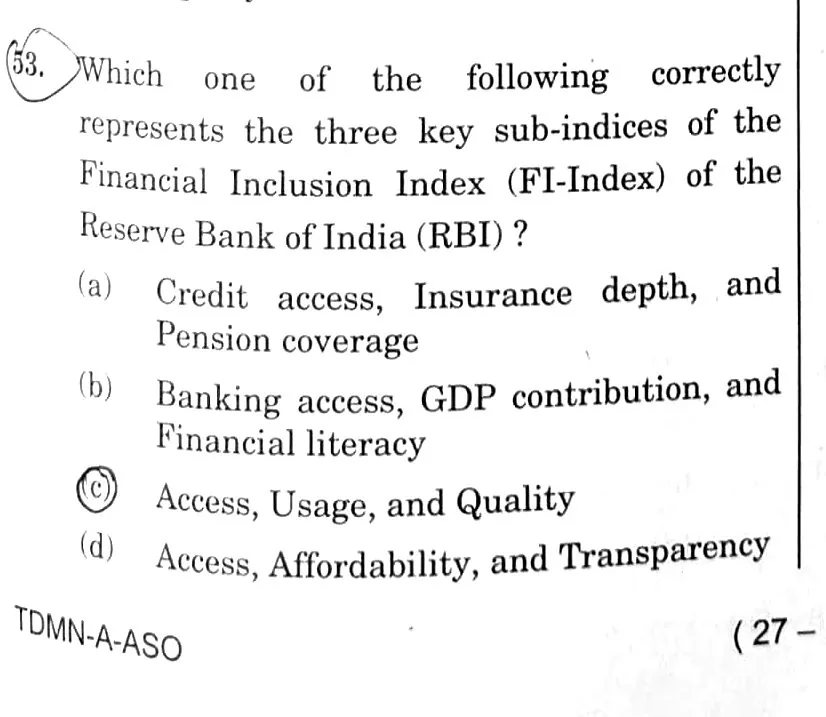
UPSC Prelims 2026, GS Series D, Q53. Which one of the following correctly represents the three key sub-indices of the Financial Inclusion Index (FI-Index) of the Reserve Bank of India (RBI) ?
(a) Credit access, Insurance depth, and Pension coverage (b) Banking access, GDP contribution, and Financial literacy (c) Access, Usage, and Quality (d) Access, Affordability, and Transparency
Section 03 · 10 questions
Science-Tech, Polity & IR
Frontier science, defence, the institutions of state and the world stage.
Sci & Tech·UPSC Q73Covered19/28
GenomeIndia Project
Our mockOur mock
We covered GenomeIndia. Came as UPSC Q73.
The note, as text
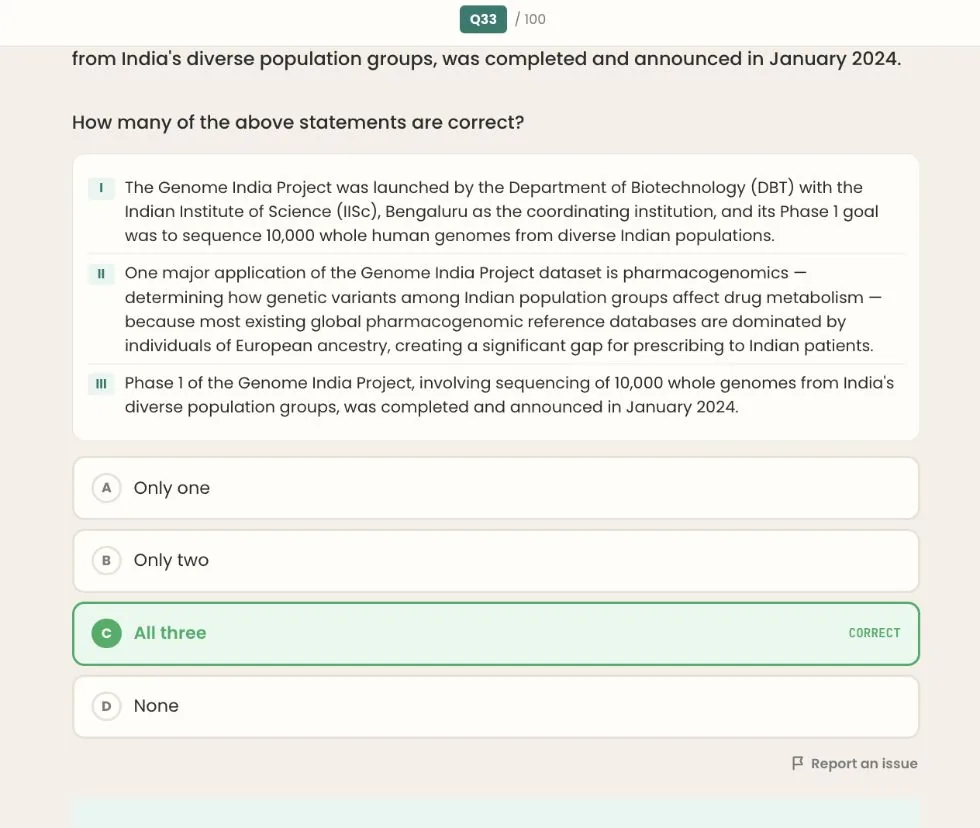
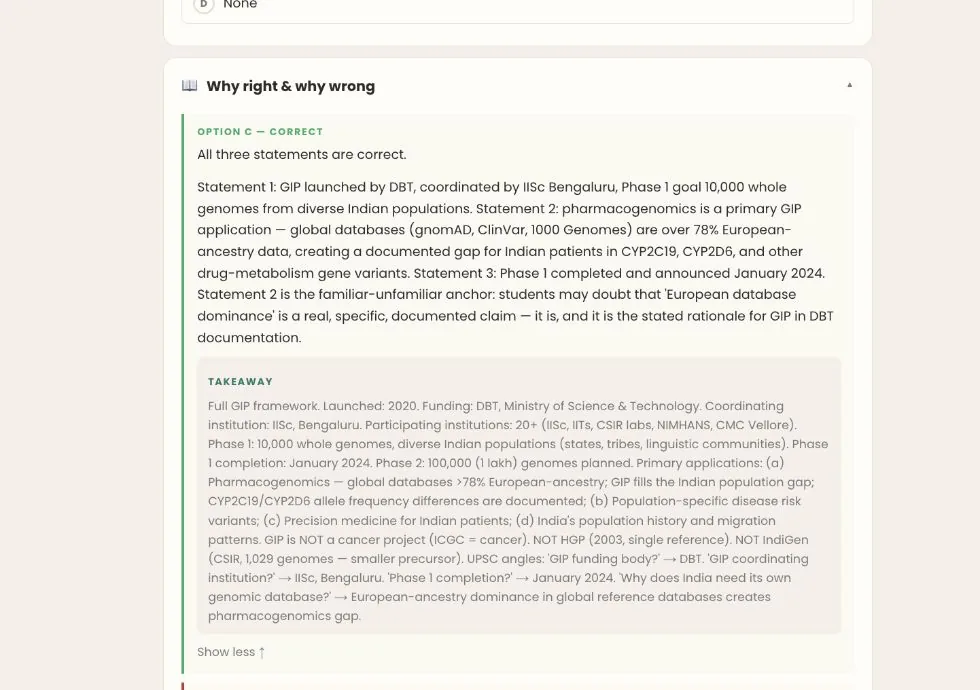
BLOOM mock question on the GenomeIndia Project, with explanation: the Department of Biotechnology (DBT) launched it, with IISc Bengaluru as the coordinating institution.
Phase 1 aimed to sequence 10,000 whole genomes from diverse Indian populations and was completed in January 2024. Phase 2 plans 1 lakh (100,000) genomes.
The explanation says it is not the 2003 Human Genome Project (single reference genome). A main use is pharmacogenomics, because global databases are dominated by European ancestry data.
The UPSC question: GS Series D, Q73
The actual paper · GS Series D · Q73
The question, as text
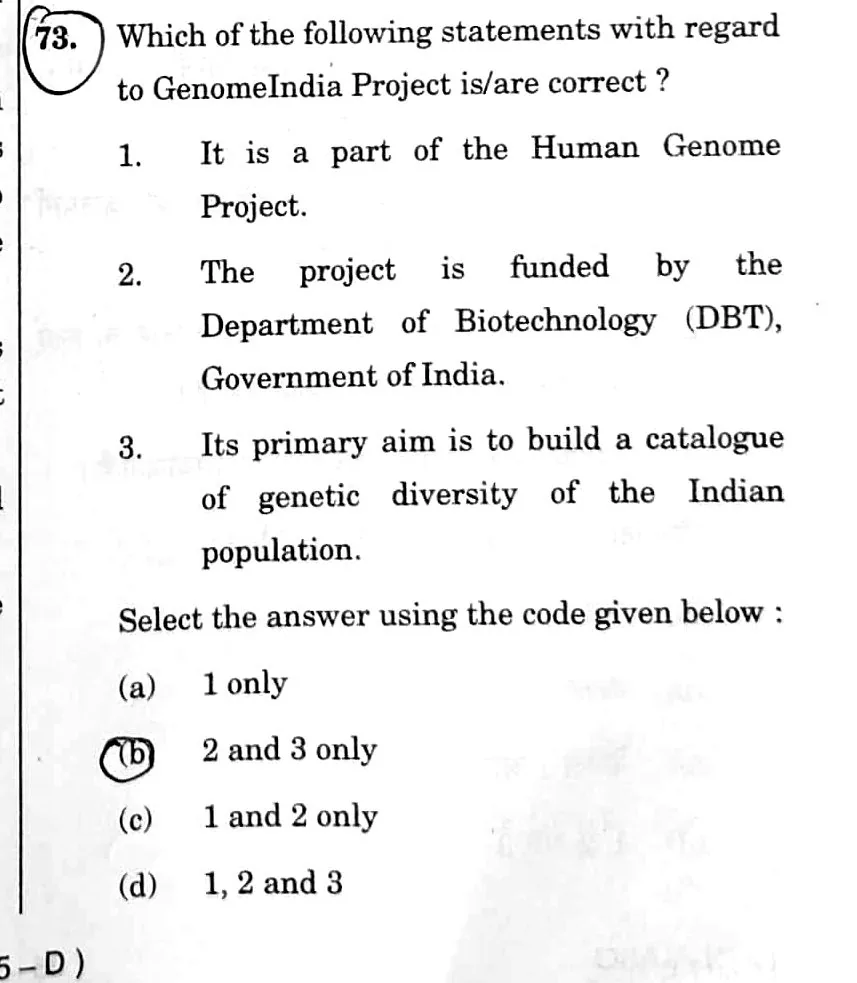
UPSC Prelims 2026, GS Series D, Q73. Which of the following statements with regard to GenomeIndia Project is/are correct ?
1. It is a part of the Human Genome Project.
2. The project is funded by the Department of Biotechnology (DBT), Government of India.
3. Its primary aim is to build a catalogue of genetic diversity of the Indian population.
Select the answer using the code given below : (a) 1 only (b) 2 and 3 only (c) 1 and 2 only (d) 1, 2 and 3
Intl. Relations·UPSC Q41Covered20/28
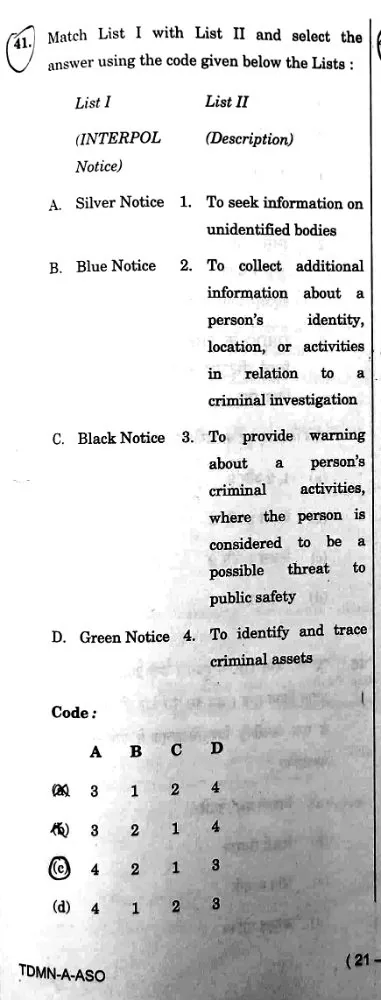
INTERPOL Notices
Our mockOur mock
We covered the INTERPOL notices, Silver included: the new asset-tracing notice India has joined. Came as UPSC Q41.
The note, as text
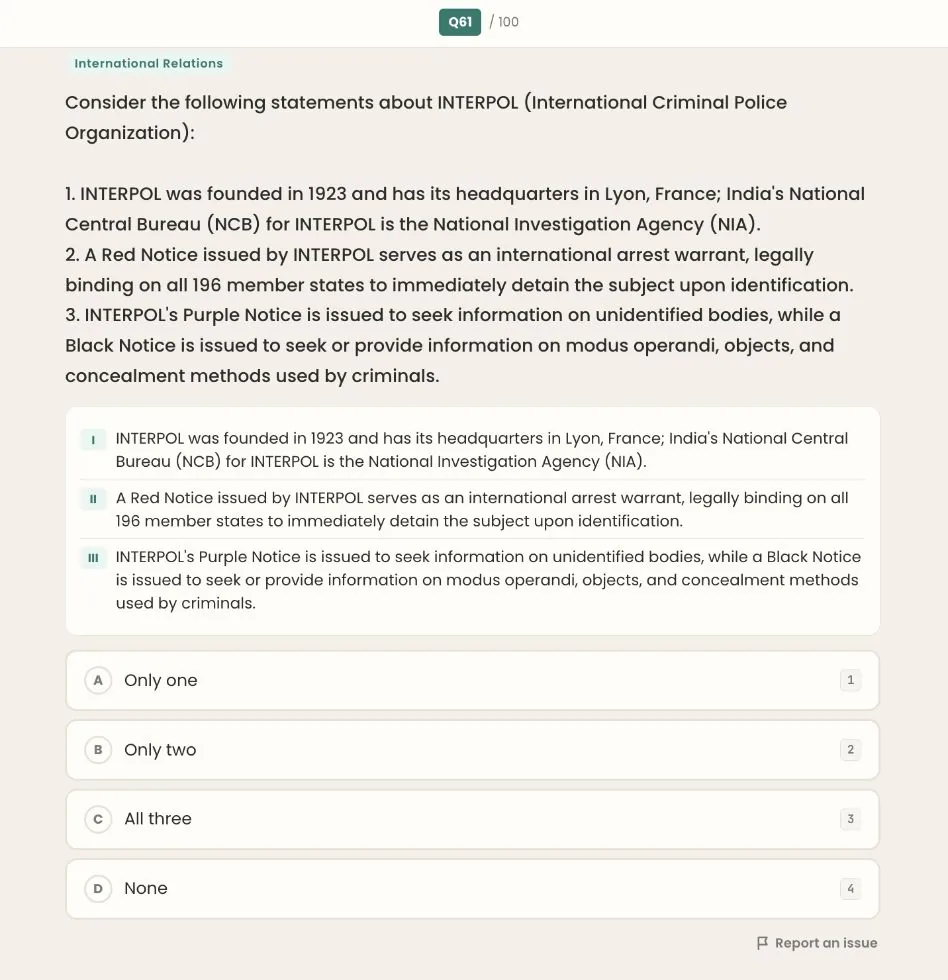
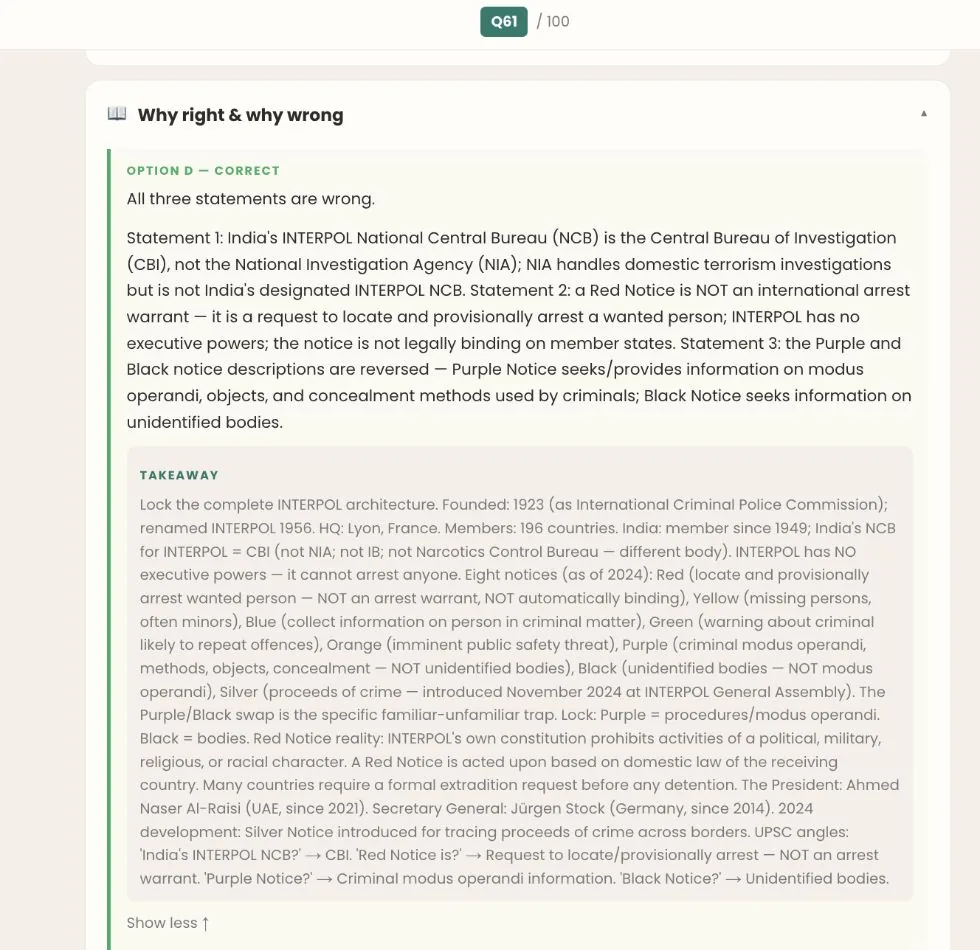
BLOOM mock question on INTERPOL, with explanation: founded in 1923, headquarters in Lyon, France, 196 member countries, and India's National Central Bureau is the CBI.
Notices listed: Red (locate and provisionally arrest), Yellow (missing persons), Blue (information on a person), Green (warning), Orange (imminent threat), Purple (modus operandi), Black (unidentified bodies).
Silver Notice: proceeds of crime, introduced November 2024 at the INTERPOL General Assembly, for tracing criminal assets across borders.
The UPSC question: GS Series D, Q41
The actual paper · GS Series D · Q41
The question, as text
UPSC Prelims 2026, GS Series D, Q41. Match List I with List II and select the answer using the code given below the Lists :
List I (INTERPOL Notice) / List II (Description)
A. Silver Notice - 1. To seek information on unidentified bodies
B. Blue Notice - 2. To collect additional information about a person's identity, location, or activities in relation to a criminal investigation
C. Black Notice - 3. To provide warning about a person's criminal activities, where the person is considered to be a possible threat to public safety
D. Green Notice - 4. To identify and trace criminal assets
Code : A B C D (a) 3 1 2 4 (b) 3 2 1 4 (c) 4 2 1 3 (d) 4 1 2 3. Options (a) and (b) are partly covered by pen marks, so their letters are hard to read in this picture of the paper.
Sci & Tech·UPSC Q75Covered21/28
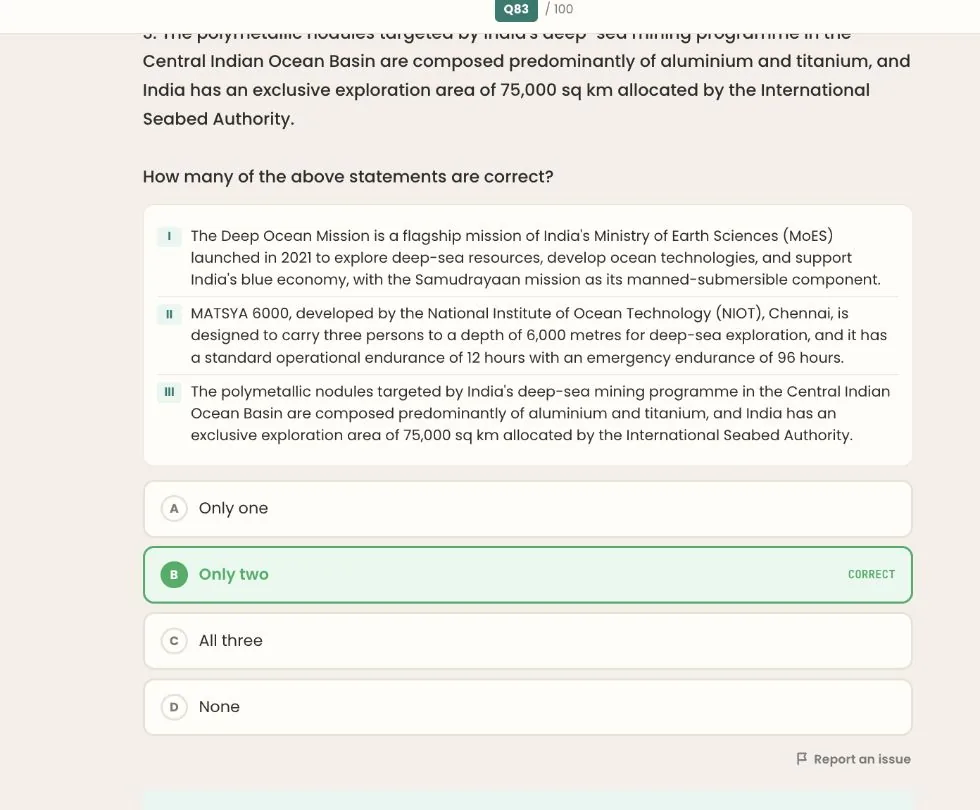
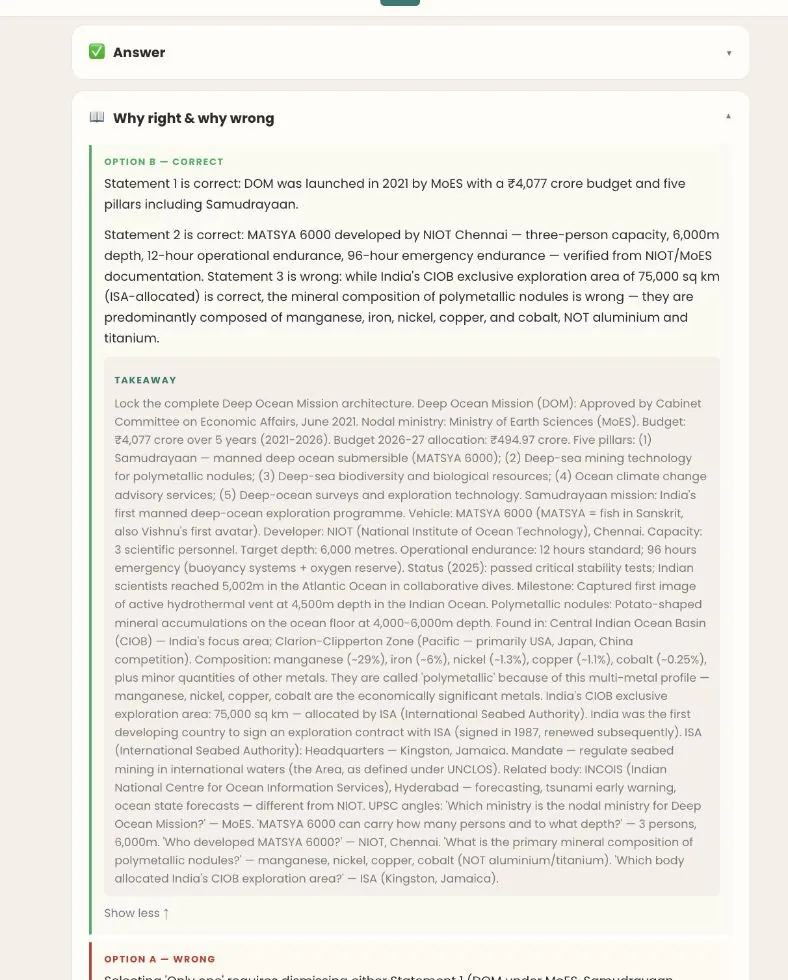
Deep Ocean Mission
Our mockOur mock
We covered the Deep Ocean Mission. Came as UPSC Q75.
The note, as text
BLOOM mock question on the Deep Ocean Mission, with explanation: launched in 2021 by the Ministry of Earth Sciences (MoES) with a budget of Rs 4,077 crore over five years.
It has five pillars, including Samudrayaan, the manned submersible mission. MATSYA 6000, developed by NIOT Chennai, carries 3 persons to a depth of 6,000 metres.
The explanation says polymetallic nodules are mainly manganese, iron, nickel, copper and cobalt, not aluminium or titanium. India's exploration area is 75,000 sq km, allocated by the ISA.
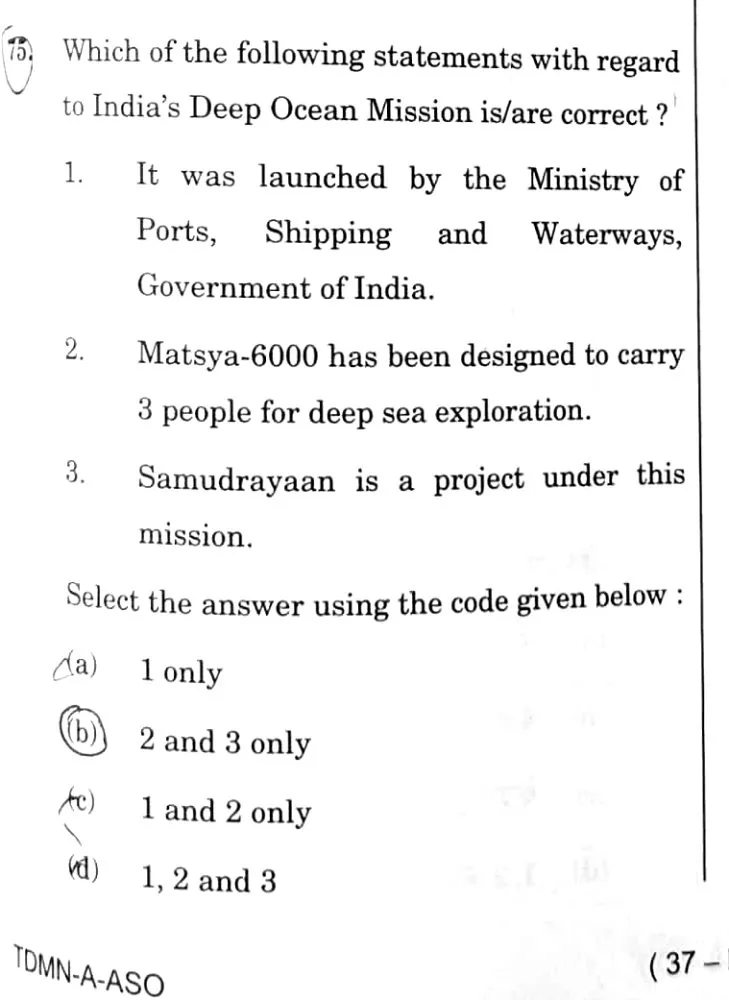
The UPSC question: GS Series D, Q75
The actual paper · GS Series D · Q75
The question, as text
UPSC Prelims 2026, GS Series D, Q75. Which of the following statements with regard to India's Deep Ocean Mission is/are correct ?
1. It was launched by the Ministry of Ports, Shipping and Waterways, Government of India.
2. Matsya-6000 has been designed to carry 3 people for deep sea exploration.
3. Samudrayaan is a project under this mission.
Select the answer using the code given below : (a) 1 only (b) 2 and 3 only (c) 1 and 2 only (d) 1, 2 and 3
Sci & Tech·UPSC Q74Covered22/28
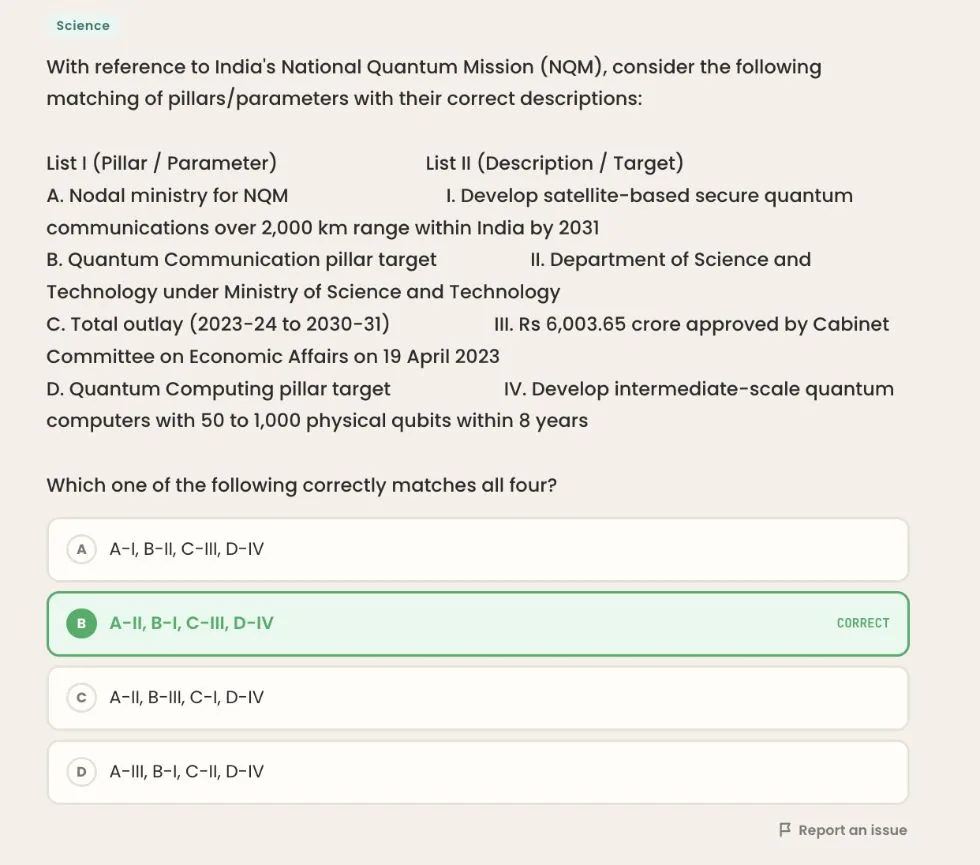
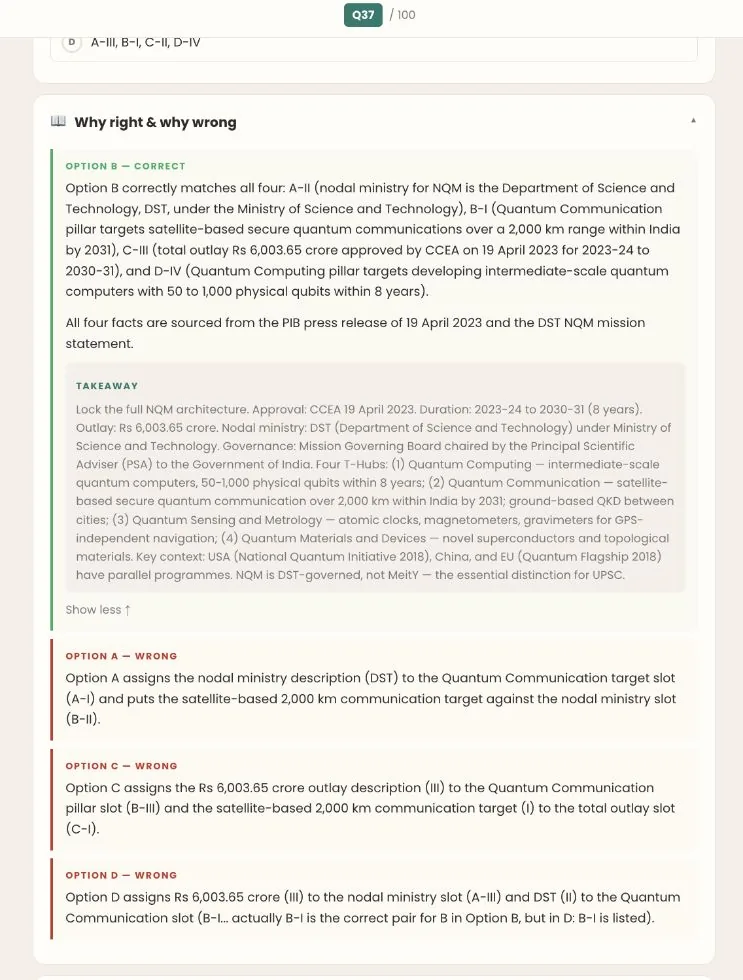
National Quantum Mission
Our mockOur mock
We covered the National Quantum Mission. Came as UPSC Q74.
The note, as text
BLOOM mock question on the National Quantum Mission (NQM), with explanation: the Cabinet Committee on Economic Affairs approved it on 19 April 2023 with an outlay of Rs 6,003.65 crore for 2023-24 to 2030-31.
The Department of Science and Technology is the nodal ministry. The Quantum Computing target is intermediate-scale quantum computers with 50 to 1,000 physical qubits within 8 years.
The takeaway lists four T-Hubs: Quantum Computing, Quantum Communication, Quantum Sensing and Metrology, and Quantum Materials and Devices. Communication aims at satellite-based secure links over 2,000 km by 2031.
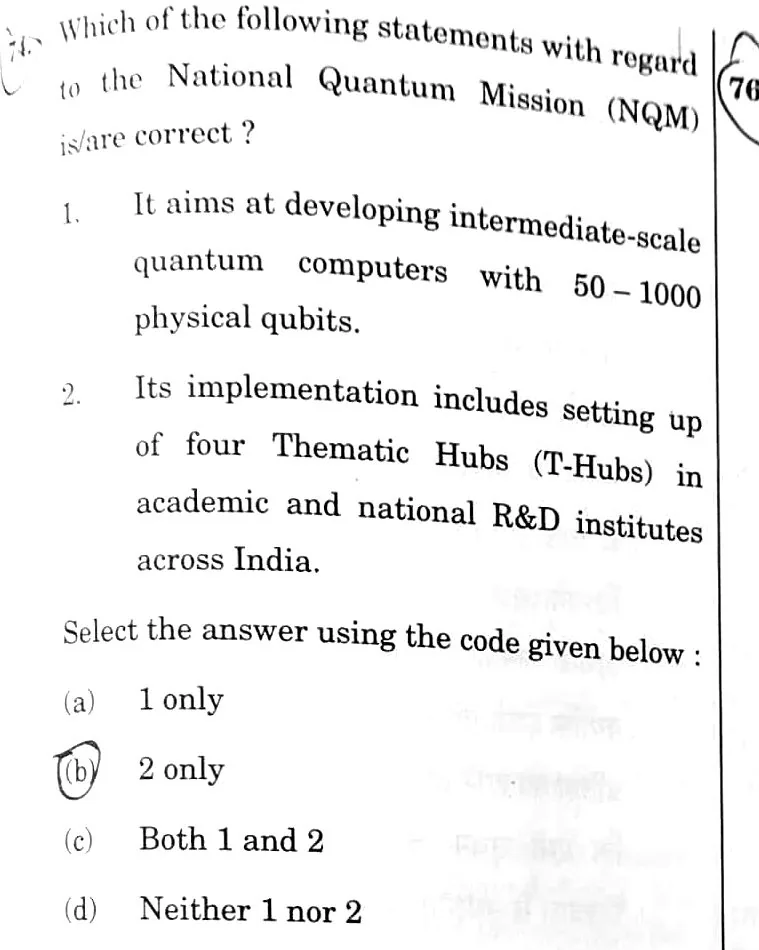
The UPSC question: GS Series D, Q74
The actual paper · GS Series D · Q74
The question, as text
UPSC Prelims 2026, GS Series D, Q74. Which of the following statements with regard to the National Quantum Mission (NQM) is/are correct ?
1. It aims at developing intermediate-scale quantum computers with 50 - 1000 physical qubits.
2. Its implementation includes setting up of four Thematic Hubs (T-Hubs) in academic and national R&D institutes across India.
Select the answer using the code given below : (a) 1 only (b) 2 only (c) Both 1 and 2 (d) Neither 1 nor 2. The question number is faint and partly cut off at the top left (it appears to read 74); the next question's number 76 shows on the right edge in this picture of the paper.
Sci & Tech·UPSC Q71Topic covered23/28
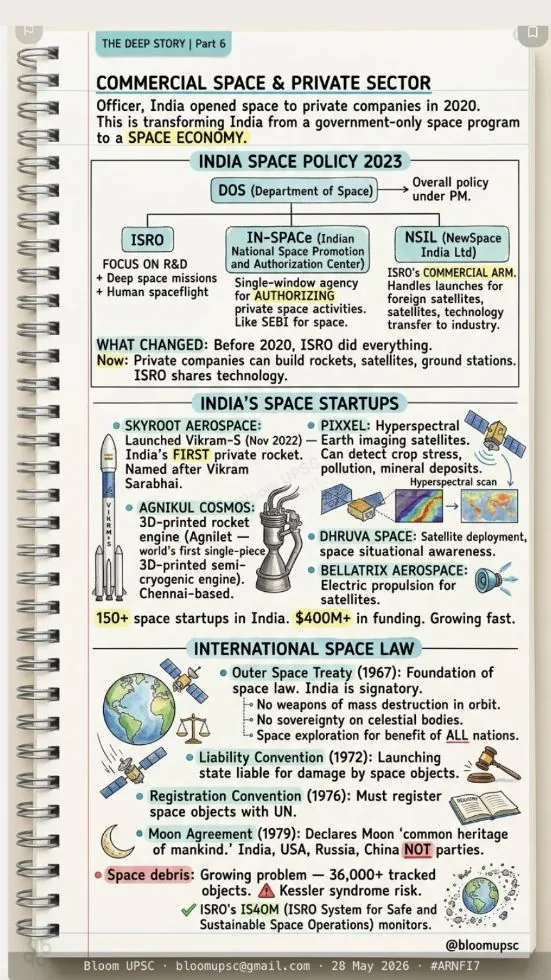
Private space (IN-SPACe)
Our noteOur mockOur mock
We covered private players in India’s space programme. Came as UPSC Q71.
The note, as text
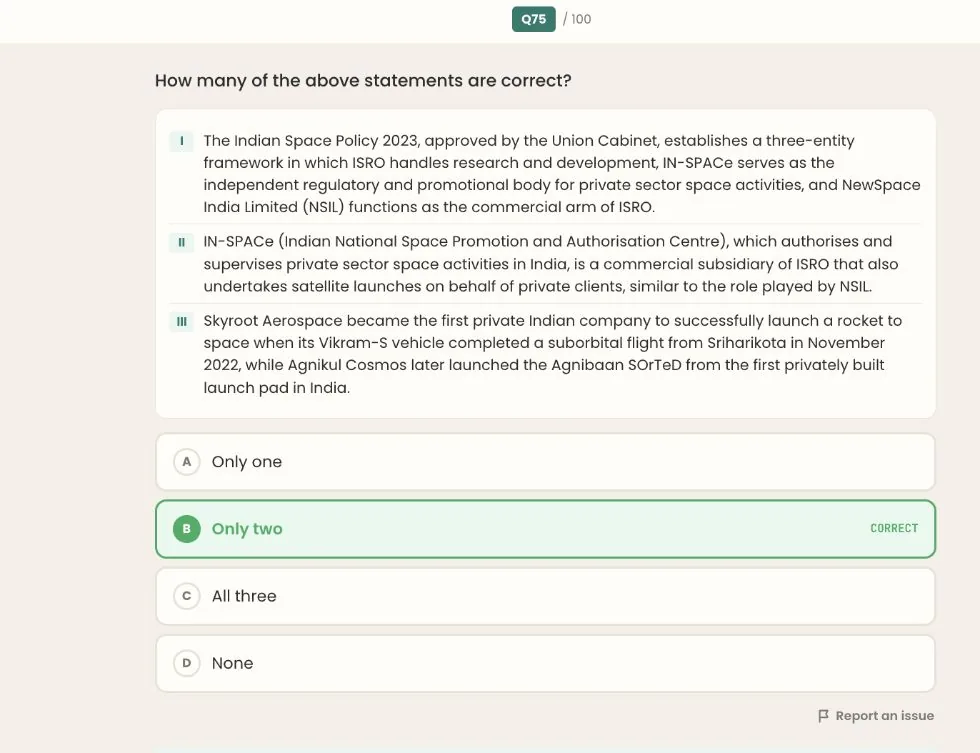
BLOOM note on commercial space and the private sector: India opened space to private companies in 2020, and IN-SPACe is the single-window agency that authorises private space activities.
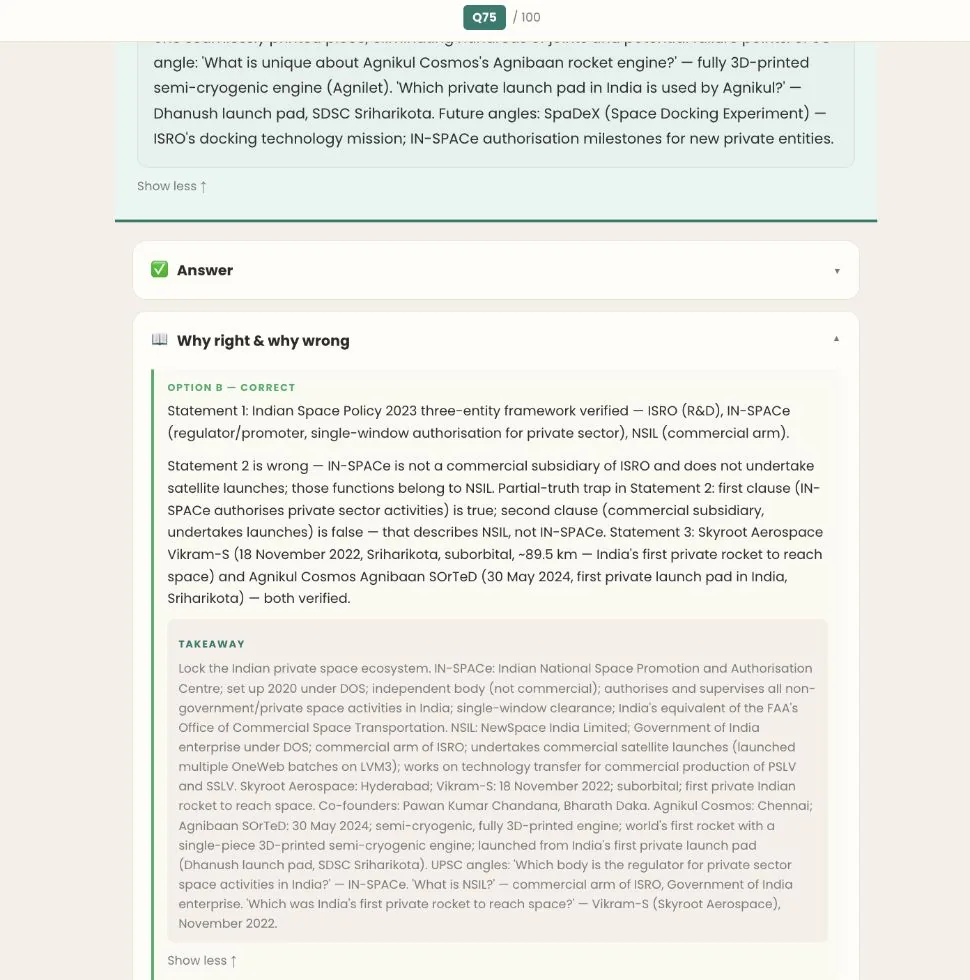
BLOOM mock question on the Indian Space Policy 2023: ISRO handles research, IN-SPACe is the regulator and promoter, and NewSpace India Limited (NSIL) is the commercial arm of ISRO.
The note names Skyroot's Vikram-S (November 2022) as India's first private rocket, and Agnikul Cosmos's Agnilet, a 3D-printed single-piece semi-cryogenic engine, made in Chennai.
The UPSC question: GS Series D, Q71
The actual paper · GS Series D · Q71
The question, as text
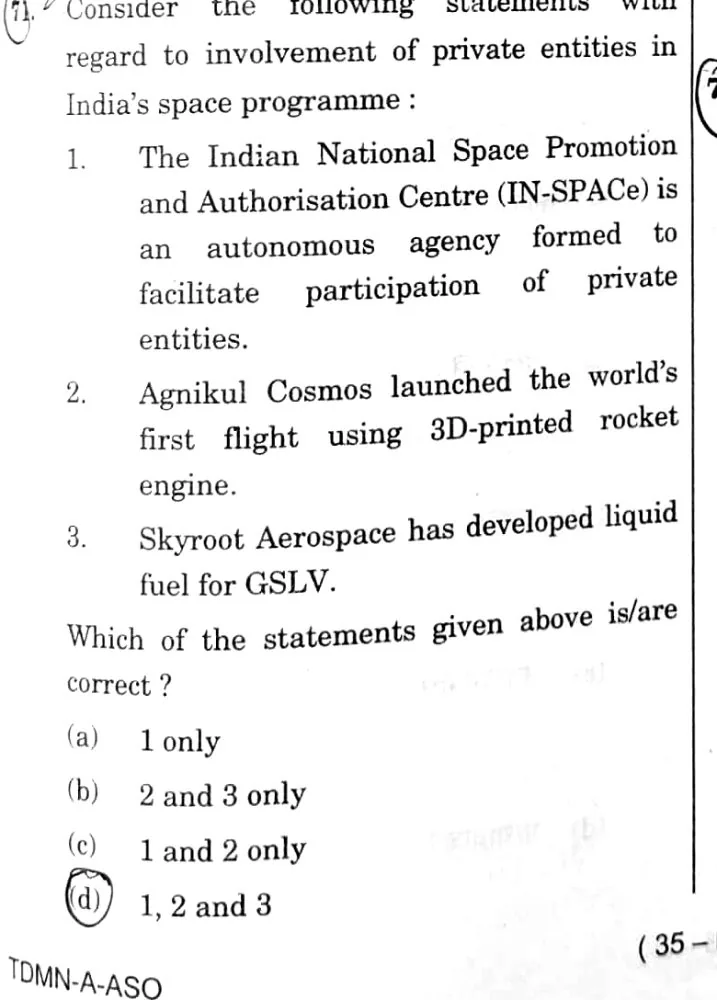
UPSC Prelims 2026, GS Series D, Q71. Consider the following statements with regard to involvement of private entities in India's space programme :
The Indian National Space Promotion and Authorisation Centre (IN-SPACe) is an autonomous agency formed to facilitate participation of private entities.
Agnikul Cosmos launched the world's first flight using 3D-printed rocket engine.
Skyroot Aerospace has developed liquid fuel for GSLV.
Which of the statements given above is/are correct ? (a) 1 only (b) 2 and 3 only (c) 1 and 2 only (d) 1, 2 and 3. The first line of the stem is partly cut off at the top of the picture in this picture of the paper.
Sci & Tech·UPSC Q69Topic covered24/28
Aircraft Black Boxes
Our mockOur mock
We covered aircraft black boxes. Came as UPSC Q69.
The note, as text
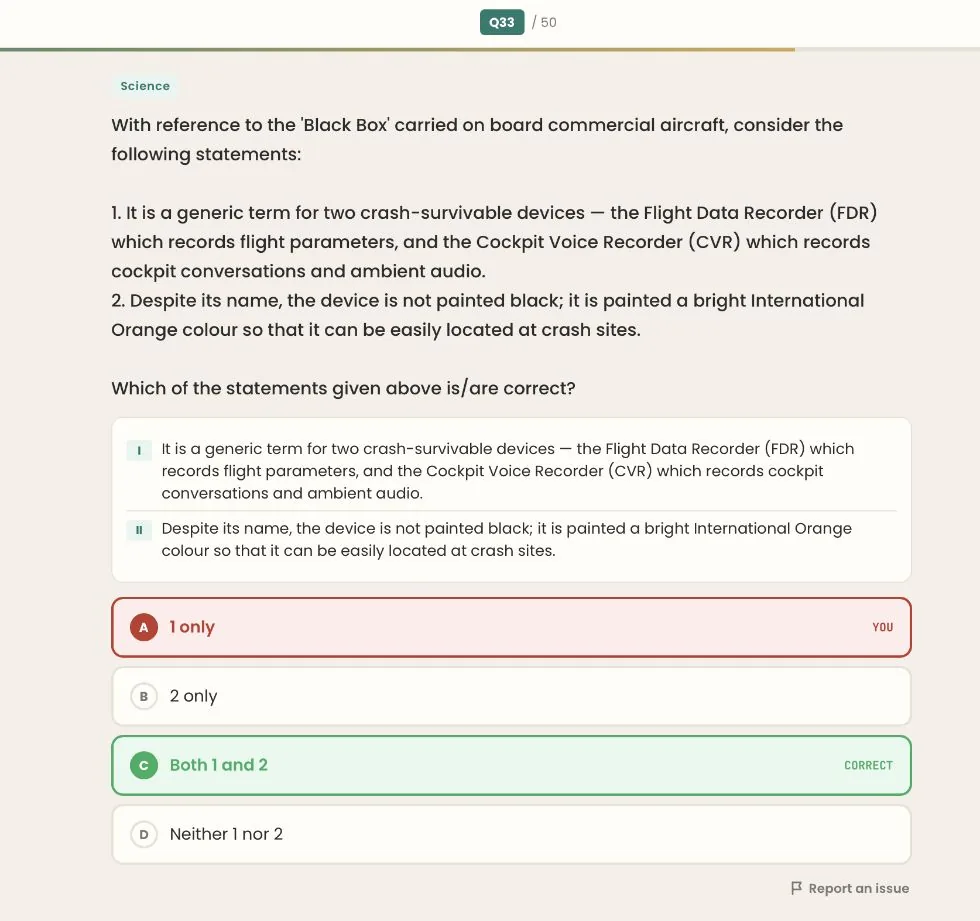
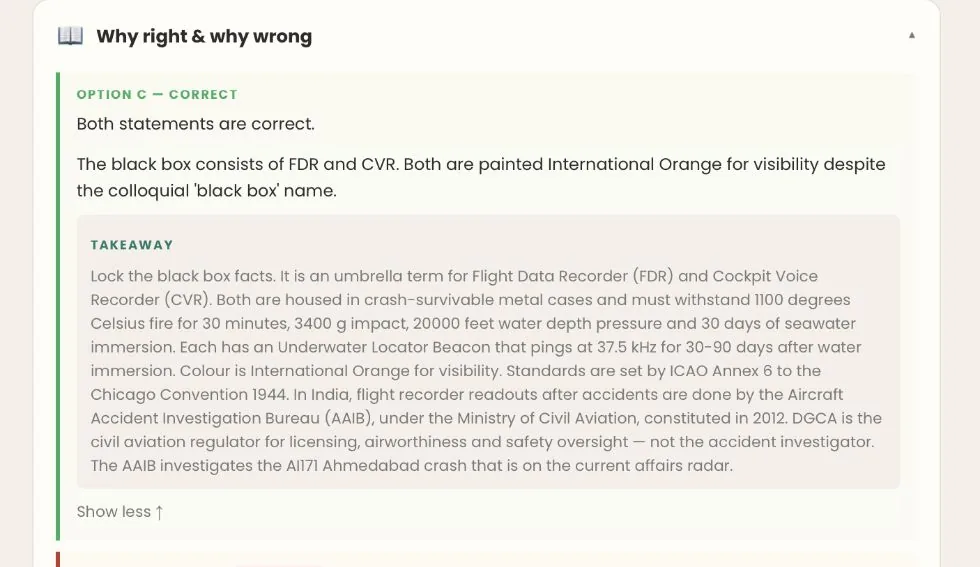
BLOOM mock question: the black box is a generic term for two crash-survivable devices, the Flight Data Recorder (FDR) and the Cockpit Voice Recorder (CVR).
The explanation says both are painted International Orange for visibility, and each carries an Underwater Locator Beacon that pings at 37.5 kHz for 30 to 90 days after water immersion.
It adds that the cases must withstand 1100 degrees Celsius fire for 30 minutes and 3400 g impact, and that the Aircraft Accident Investigation Bureau (AAIB) reads recorder data in India.
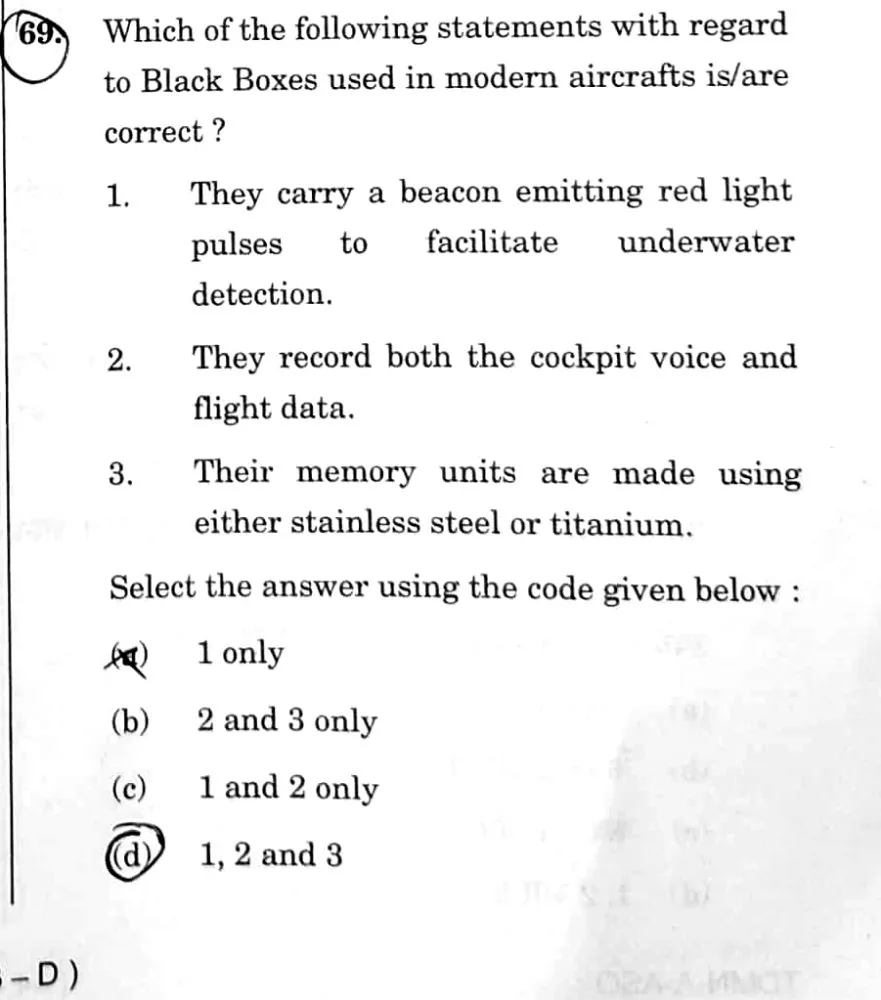
The UPSC question: GS Series D, Q69
The actual paper · GS Series D · Q69
The question, as text
UPSC Prelims 2026, GS Series D, Q69. Which of the following statements with regard to Black Boxes used in modern aircrafts is/are correct ?
They carry a beacon emitting red light pulses to facilitate underwater detection.
They record both the cockpit voice and flight data.
Their memory units are made using either stainless steel or titanium.
Select the answer using the code given below : (a) 1 only (b) 2 and 3 only (c) 1 and 2 only (d) 1, 2 and 3
Sci & Tech·UPSC Q66Topic covered25/28
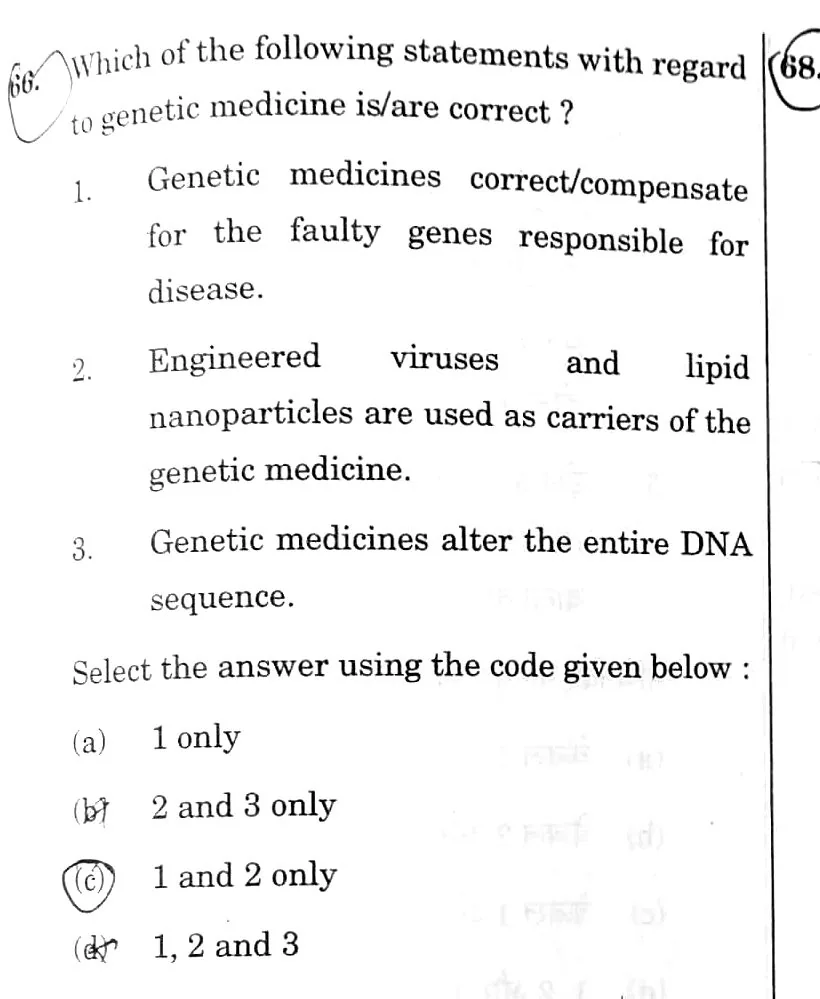
Genetic medicine
Our noteOur note
We covered genetic medicine. Came as UPSC Q66.
The note, as text
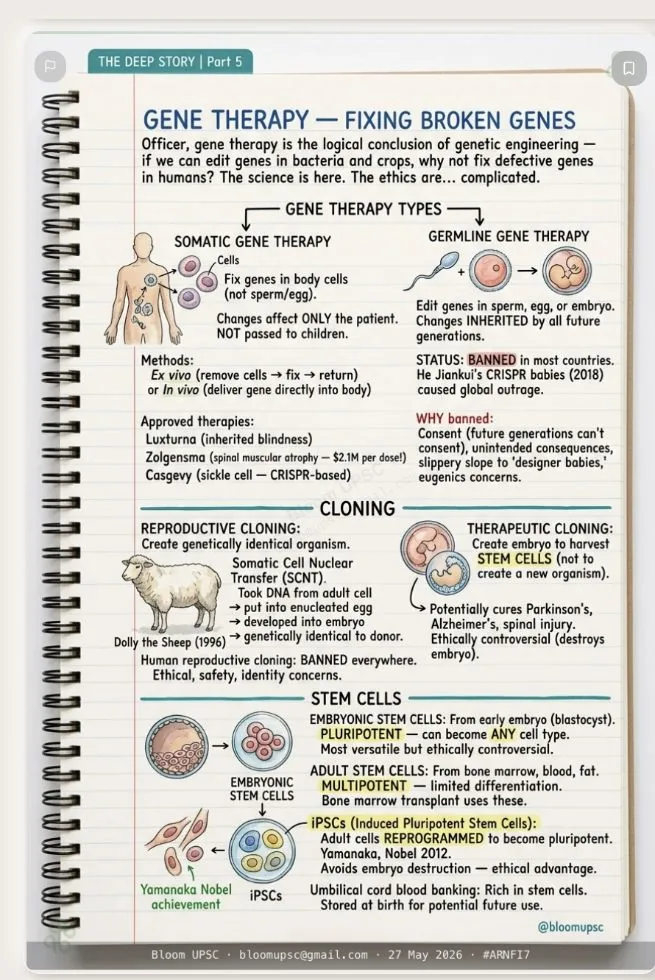
BLOOM note on gene therapy: somatic therapy fixes genes in body cells and is not passed to children, while germline therapy edits sperm, egg or embryo and is inherited.
Germline editing is banned in most countries. The note lists approved therapies Luxturna (inherited blindness), Zolgensma (spinal muscular atrophy) and Casgevy (sickle cell, CRISPR-based).
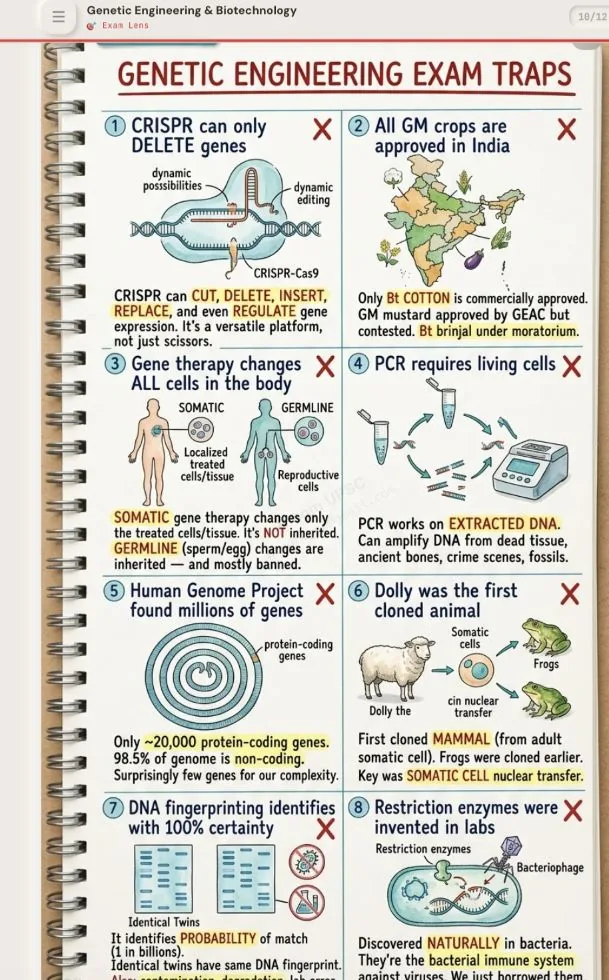
BLOOM exam traps note: gene therapy does not change all cells in the body. Somatic therapy changes only the treated cells or tissue and the change is not inherited.
The UPSC question: GS Series D, Q66
The actual paper · GS Series D · Q66
The question, as text
UPSC Prelims 2026, GS Series D, Q66. Which of the following statements with regard to genetic medicine is/are correct ?
Genetic medicines correct/compensate for the faulty genes responsible for disease.
Engineered viruses and lipid nanoparticles are used as carriers of the genetic medicine.
Genetic medicines alter the entire DNA sequence.
Select the answer using the code given below : (a) 1 only (b) 2 and 3 only (c) 1 and 2 only (d) 1, 2 and 3
Sci & Tech·UPSC Q70Covered26/28
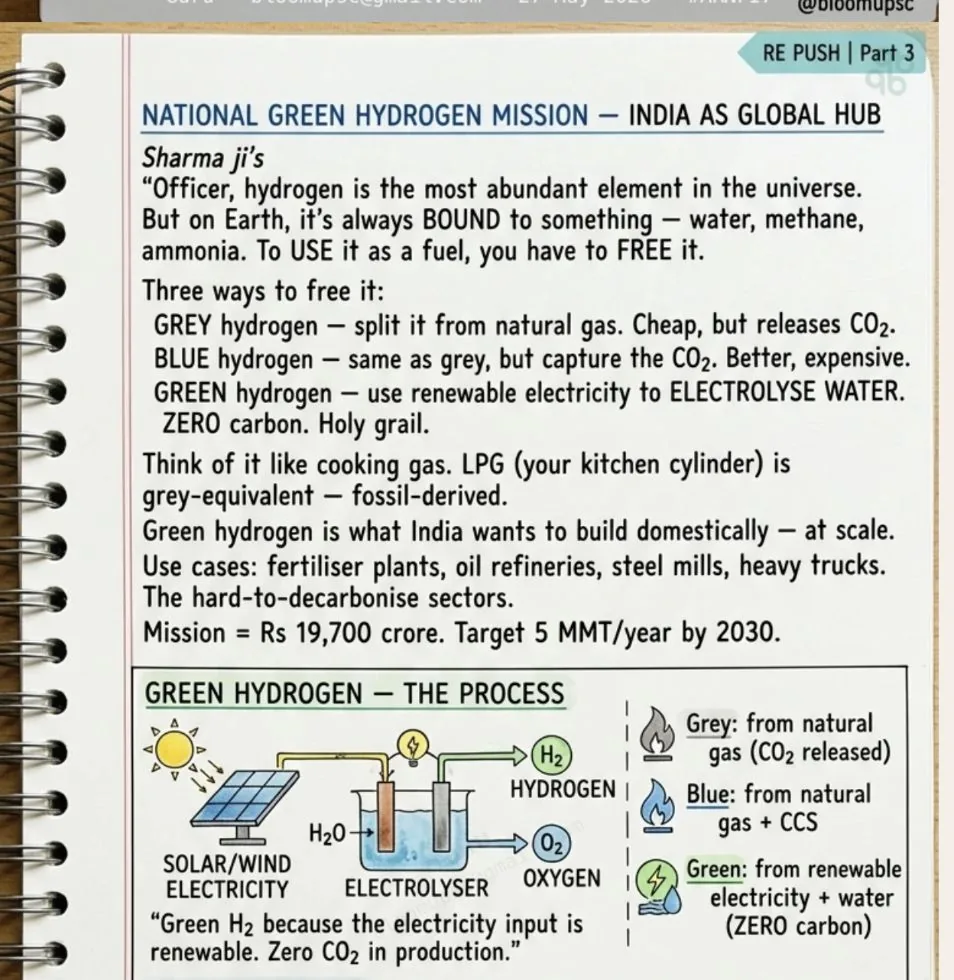
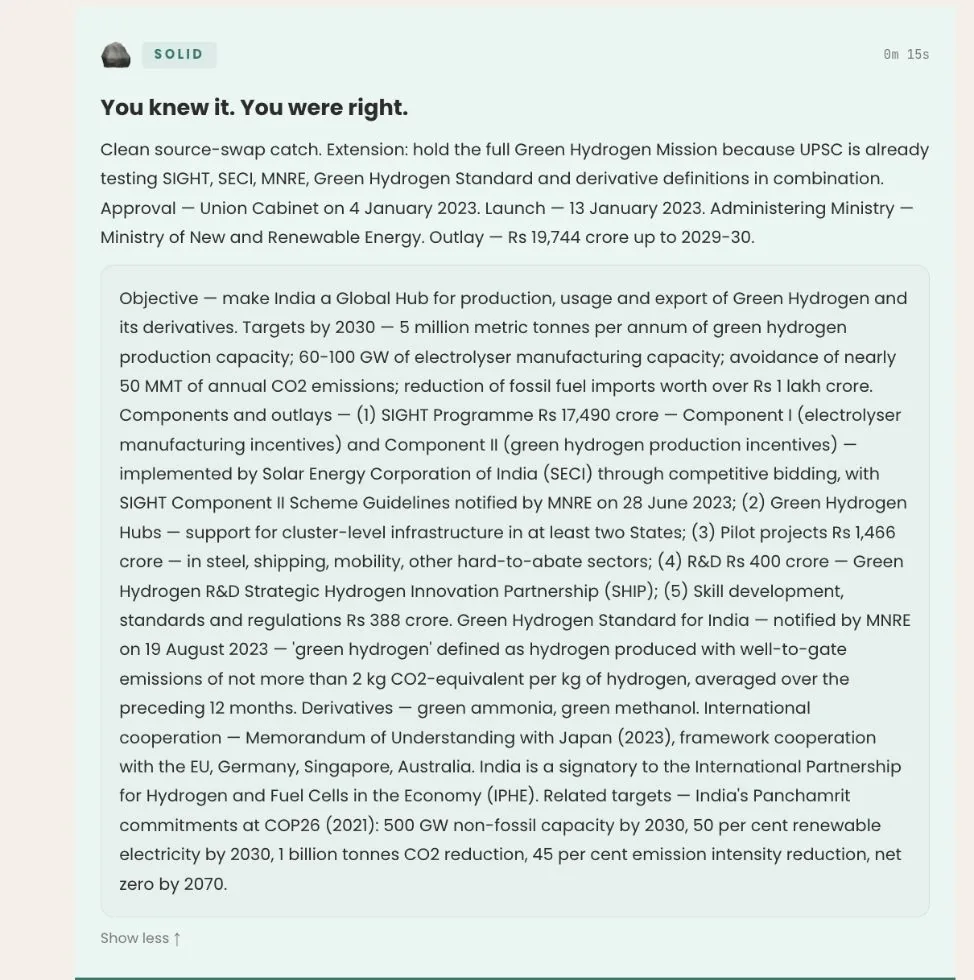
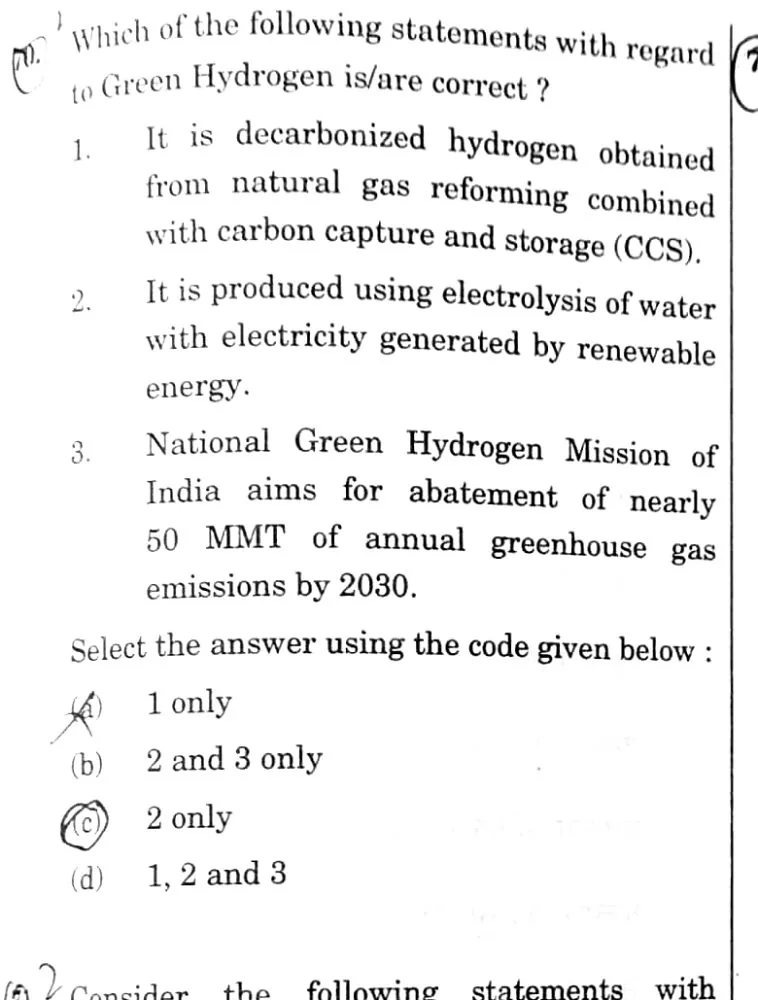
Green Hydrogen
Our noteOur mock
We covered Green Hydrogen. Came as UPSC Q70.
The note, as text
BLOOM note on the National Green Hydrogen Mission: grey hydrogen is split from natural gas and releases CO2, and blue hydrogen is the same with the CO2 captured.
Green hydrogen uses renewable electricity to electrolyse water, with zero carbon in production. The note gives a target of 5 MMT a year by 2030.
The mock explanation says the mission was approved on 4 January 2023, with targets by 2030 including nearly 50 MMT of annual CO2 emissions avoided and 60 to 100 GW of electrolyser capacity.
The UPSC question: GS Series D, Q70
The actual paper · GS Series D · Q70
The question, as text
UPSC Prelims 2026, GS Series D, Q70. Which of the following statements with regard to Green Hydrogen is/are correct ?
It is decarbonized hydrogen obtained from natural gas reforming combined with carbon capture and storage (CCS).
It is produced using electrolysis of water with electricity generated by renewable energy.
National Green Hydrogen Mission of India aims for abatement of nearly 50 MMT of annual greenhouse gas emissions by 2030.
Select the answer using the code given below : (a) 1 only (b) 2 and 3 only (c) 2 only (d) 1, 2 and 3. The question number at the top left is partly cut off in this picture of the paper.
Defence·UPSC Q93Topic covered27/28
Defence manufacturing
Our note
We covered defence manufacturing. Came as UPSC Q93.
The note, as text
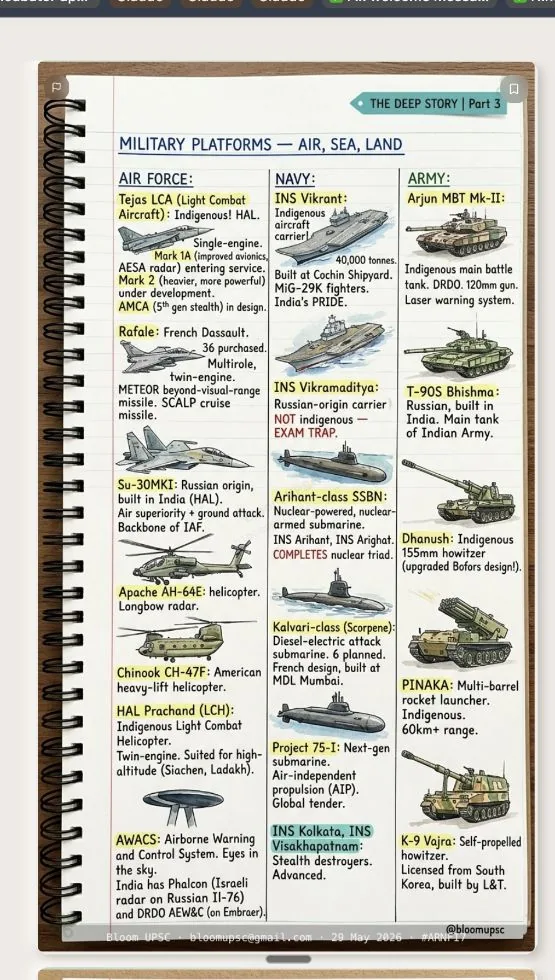
BLOOM note on military platforms: the Su-30MKI is of Russian origin, built in India by HAL, and is the backbone of the Indian Air Force.
The T-90S Bhishma is Russian in origin, built in India, and is the main tank of the Indian Army. The note also lists Dhanush, Pinaka and K-9 Vajra.
The note marks INS Vikramaditya as Russian-origin and not indigenous, and says the Kalvari-class submarine has a French design and is built by MDL in Mumbai.
The UPSC question: GS Series D, Q93
The actual paper · GS Series D · Q93
The question, as text
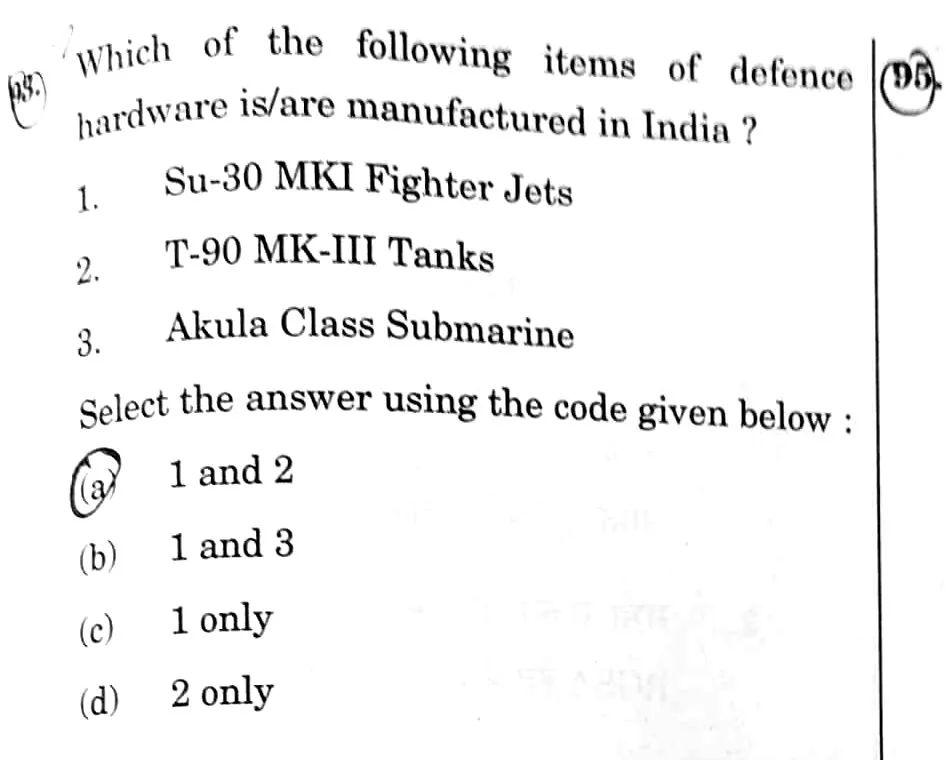
UPSC Prelims 2026, GS Series D, Q93. Which of the following items of defence hardware is/are manufactured in India ?
Su-30 MKI Fighter Jets
T-90 MK-III Tanks
Akula Class Submarine
Select the answer using the code given below : (a) 1 and 2 (b) 1 and 3 (c) 1 only (d) 2 only
Polity·UPSC Q83Covered28/28
Parliament questions
Our note
We covered starred / unstarred questions. Came as UPSC Q83.
The note, as text
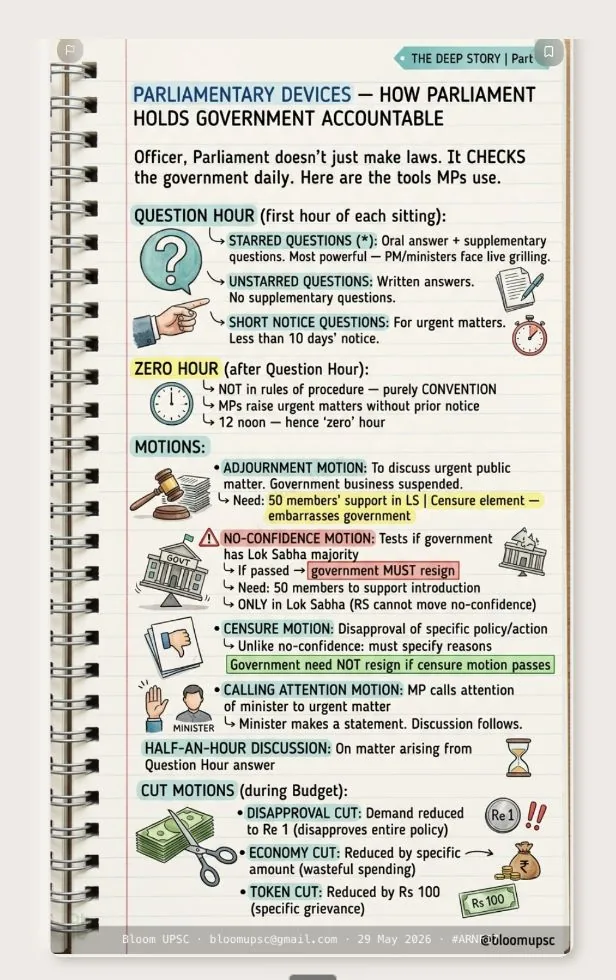
BLOOM note on parliamentary devices: starred questions get an oral answer plus supplementary questions, and unstarred questions get written answers with no supplementary questions.
Short notice questions are for urgent matters with less than 10 days' notice. Question Hour is the first hour of each sitting, and Zero Hour follows it.
The note also covers motions: adjournment, no-confidence (only in Lok Sabha, and the government must resign if it passes), censure, calling attention, and the three cut motions.
The UPSC question: GS Series D, Q83
The actual paper · GS Series D · Q83
The question, as text
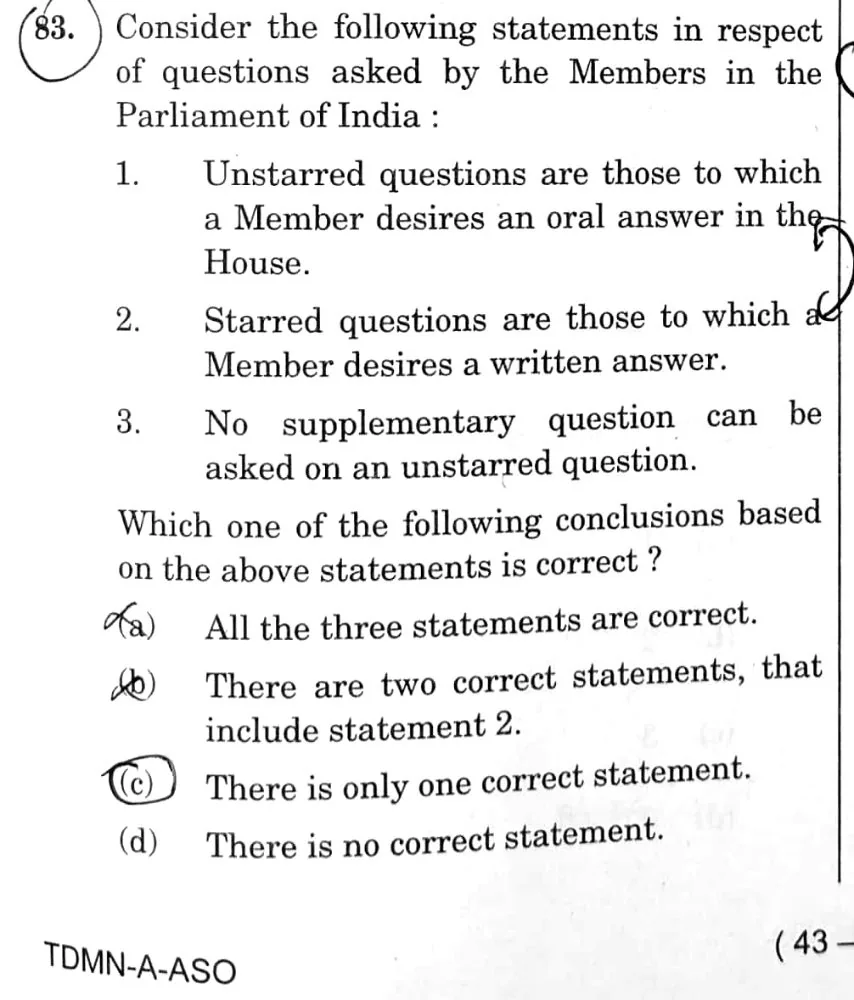
UPSC Prelims 2026, GS Series D, Q83. Consider the following statements in respect of questions asked by the Members in the Parliament of India :
Unstarred questions are those to which a Member desires an oral answer in the House.
Starred questions are those to which a Member desires a written answer.
No supplementary question can be asked on an unstarred question.
Which one of the following conclusions based on the above statements is correct ? (a) All the three statements are correct. (b) There are two correct statements, that include statement 2. (c) There is only one correct statement. (d) There is no correct statement.. The right edge of statements 1 and 2 is slightly covered by a pen mark in this picture of the paper.